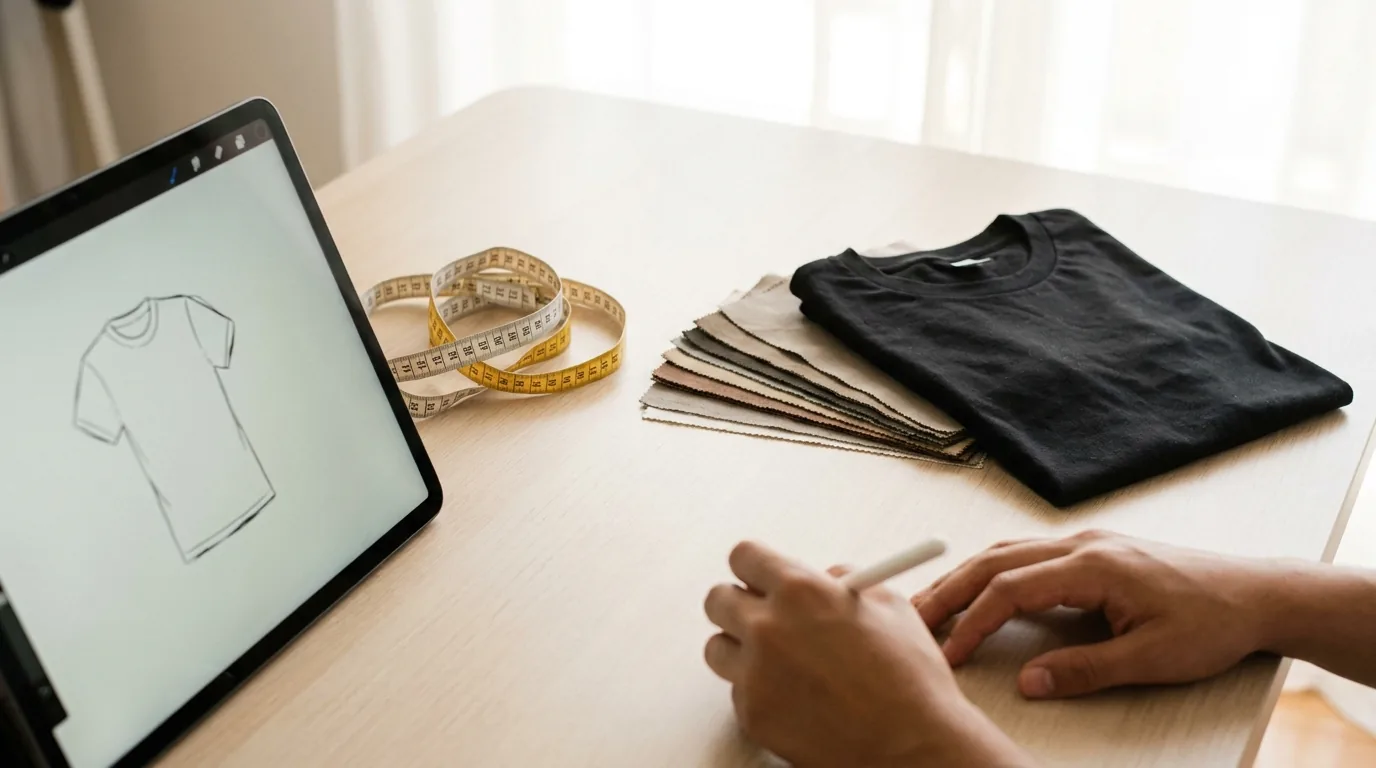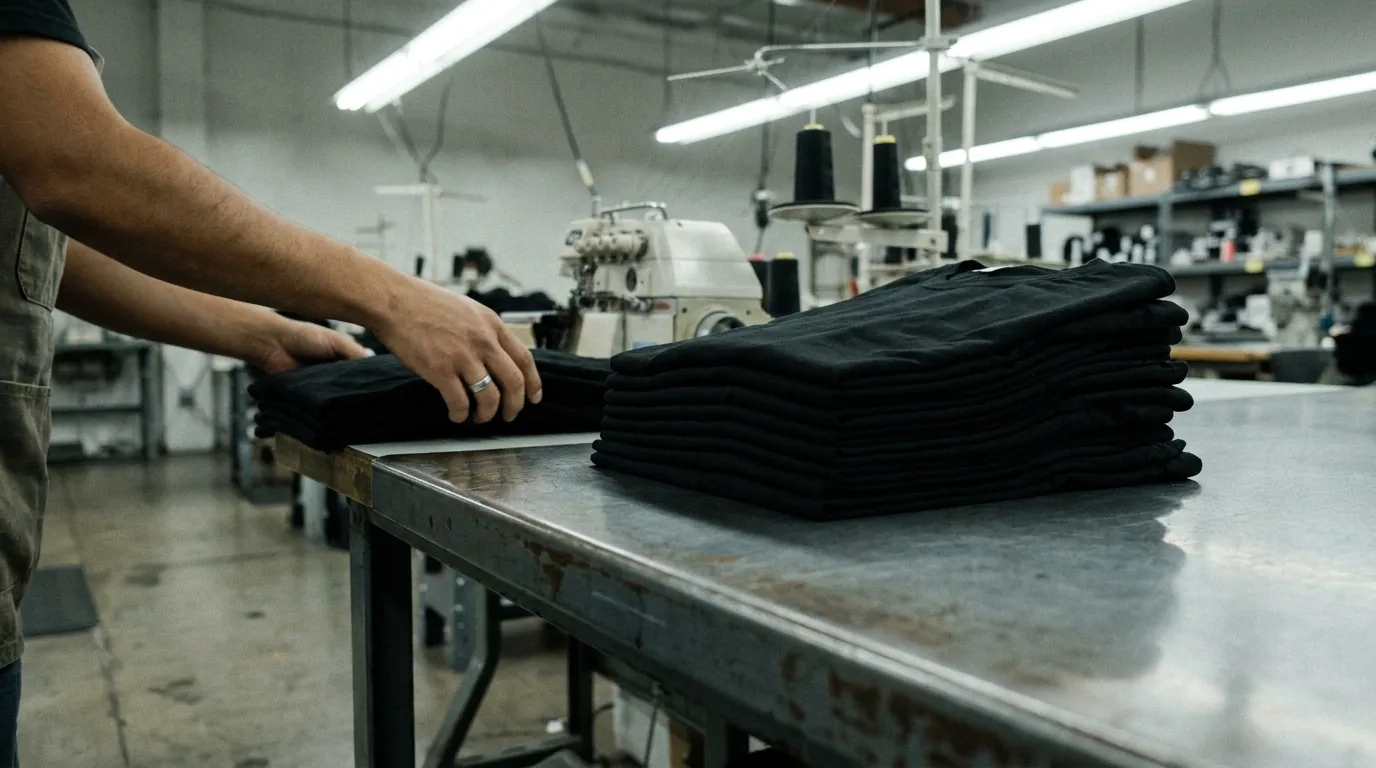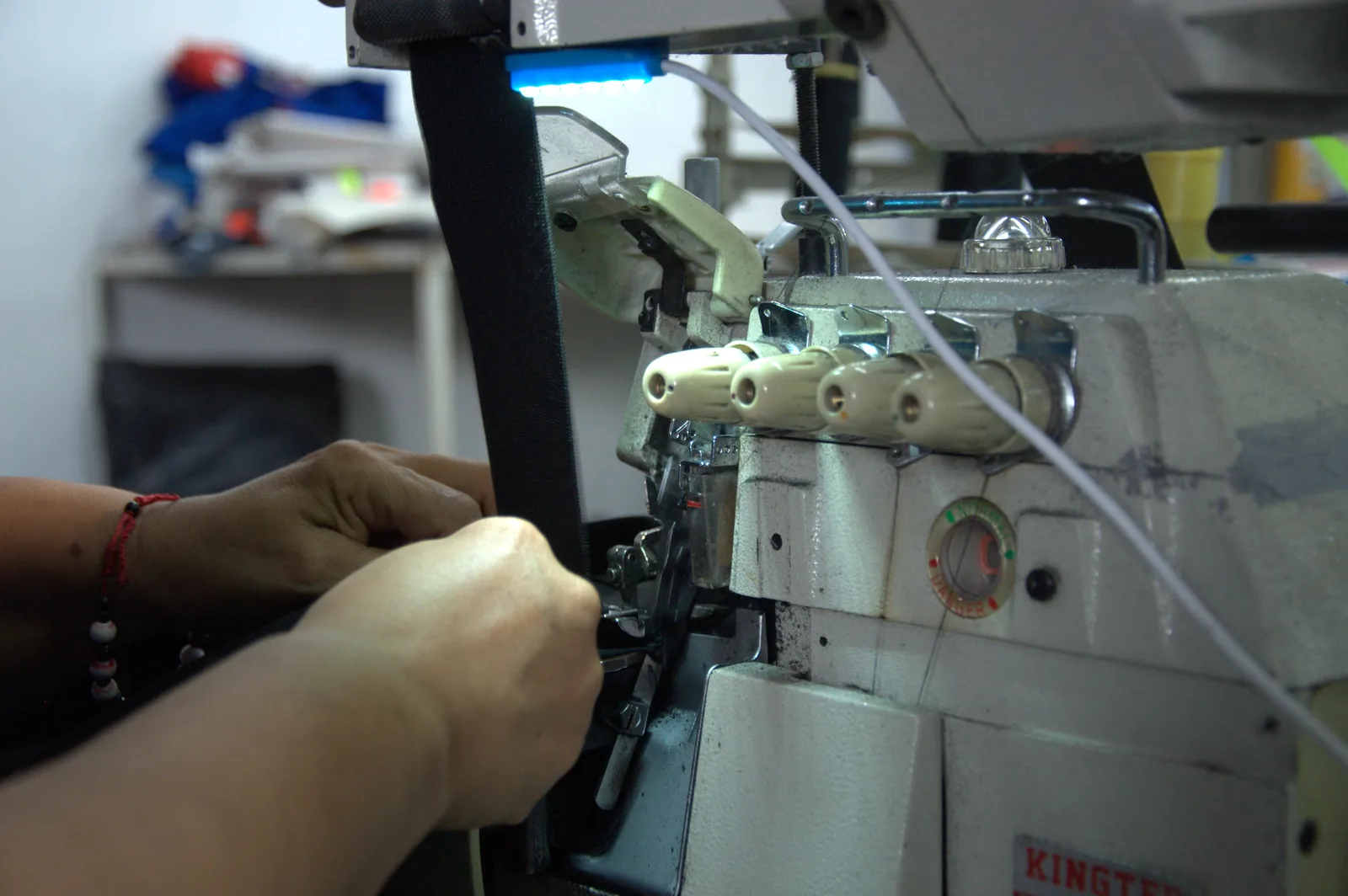

Every fabric is defined by two things: the fiber it is made of (cotton, polyester, linen, blends) and how it is built, with knit construction that stretches or woven construction that holds firm. Those two decisions, plus the weight of the cloth, decide how a garment falls, how warm it is, how long it lasts and what price it can carry at retail. There is no best fabric in the abstract. There is a right fabric for each garment and each use.
This guide is written from the manufacturer's chair, for a brand that is going to produce a range rather than sew one piece at home. That changes the whole exercise. It is not enough for the cloth to look good in a photo: the mill has to have the roll available, the color has to come back the same lot after lot, and the size has to survive twenty washes in a customer's machine. Below you will find the fabric types from the inside, a weight chart by garment you can take into your next development meeting, the tests that separate a cloth that lasts from one that pills in a season, and how fabric gets chosen when the goal is a business and not a mood board. At GAT, fabric selection is the first stage of fashion product development, not a closed swatch book you pick from.
Knit or woven: the choice that decides whether your garment stretches
Before arguing about fibers it helps to understand how the cloth is built, because that is where stretch is decided. There are two families.
Knit fabric is formed by looping a single yarn through itself, the same way hand knitting works. That loop structure lets the cloth stretch and recover, which is why it sits under almost everything people wear for comfort: t-shirts, polos, sweatshirts, underwear and activewear all come from knits.
Woven fabric crosses two sets of yarns at right angles, warp and weft, like the structure of a basket. It barely stretches and stays dimensionally stable, so it is the territory of garments with structure: shirts, trousers, clean-line dresses and tailored pieces.
The practical consequence is direct. When a brand says "I want cotton" it has not yet said the important part, because a t-shirt and a button-down can both be 100% cotton and behave in opposite ways. One stretches, the other does not. Settling knit or woven is the first thing we do when we bring your garment down to earth.
Fabric weight (GSM), and what to ask for per garment
Fabric weight is measured in GSM, grams per square meter, and US brands often see the same number expressed in ounces per square yard. It decides whether a garment comes out light and cool or heavy and full of body, and it carries as much of the result as the fiber does. A cotton tee is a completely different product at 130 GSM than at 220. These are the ranges we work to.
| Garment | Typical construction | Weight (GSM) | Approx. oz/yd² |
|---|---|---|---|
| Event or promotional tee | Cotton or blend jersey | under 130 | under 3.8 |
| Performance tee | Technical breathable knit | 120 to 150 | 3.5 to 4.4 |
| Premium everyday tee | Combed cotton jersey | 180 to 200 | 5.3 to 5.9 |
| Oversized tee with structured drape | Heavyweight jersey | 200 to 240 | 5.9 to 7.1 |
| Polo | Pique | 190 to 220 | 5.6 to 6.5 |
| Mid-season sweatshirt | French terry | 230 to 250 | 6.8 to 7.4 |
| Winter hoodie or crewneck | Brushed fleece | 280 to 350 | 8.3 to 10.3 |
Keep that chart. It is what turns "I want something thick" into a number your manufacturer can quote and a mill can supply. Getting weight wrong is expensive in a quiet way. An oversized tee in a light cloth loses the fall that defines it, and a hoodie at a low weight feels cheap the moment a customer touches it. Define the result and the retail price first, and the weight comes out of that.
Heavier does not mean better
The most common mistake is reading GSM as a grade. A 200-gram cloth spun from ordinary carded yarn can pill and lose its shape before a well-finished 180 in combed cotton. What holds quality is the yarn type, the combing, the finishing and the dimensional stability. GSM measures the weight of the cloth. The yarn and the finish decide how long the garment survives.
The fibers, one by one
To size up what clothing is actually made of today: global fiber production hit a record 132 million tonnes in 2024, and polyester alone accounts for roughly 59% of everything produced (88% of it fossil-based, meaning petroleum), followed by cotton at around 20%, according to the Textile Exchange Materials Market Report. Each fiber behaves differently, and if any term here reads unfamiliar it is defined in our apparel manufacturing glossary.
Cotton
The most used natural fiber in fashion and the one most brands ask for in tees, sweatshirts and everyday pieces. It breathes, it is comfortable, and it takes print and embroidery well. Its quality comes down to the yarn: combed cotton goes through an extra process that aligns the fibers and strips out the short ones, so it comes back smoother, more even and far less prone to pilling than carded cotton, which is cheaper and rougher to the touch. We work across cotton weights and bring in combed Peruvian cotton when a garment needs a superior hand. Cotton's weak point is that it shrinks and creases if it has not been properly pre-shrunk.
Polyester
The synthetic fiber that dominates the world market. It is strong, it dries fast, it barely shrinks or wrinkles and it costs less than cotton, which is why it rules activewear and high-volume production. In exchange it breathes less, and every wash of a polyester garment releases plastic microfibers into the water, a point we come back to further down. It is rarely used at 100% in premium everyday pieces. It performs better blended.
Poly-cotton and CVC blends
Crossing cotton with polyester goes after the best of each: the comfort and breathability of cotton with the strength and stability of the synthetic. A 65/35 blend or CVC (Chief Value Cotton, cotton-majority) wrinkles less, survives industrial laundering and holds its size, which is why it is the default for corporate and uniform programs, where a garment gets washed constantly and has to look the same for months.
Elastane (spandex, Lycra)
It does not make a fabric on its own. It is added in small proportions, usually 3% to 8%, to give elongation and recovery. A cotton jersey with 5% elastane stretches and returns without bagging at the elbows or knees. It goes in where a garment needs movement and a close fit without being a compression product. "Lycra" is a brand of elastane that became a generic name.
Viscose, modal and rayon
Fibers made from cellulose (wood pulp) that fall fluidly and feel cool and silky, which makes them a favorite for blouses and anything that needs drape. The catch is that viscose and rayon crease and shrink more, and they are less stable. Modal is the tougher, softer version with better wash behavior. Good for fall, delicate for hard use.
Linen
The warm-weather cloth, breathable and cool, with a texture nothing else imitates. It creases easily, which is part of its appeal and also its limit. It gets worked at 100% linen, blended with cotton (which cuts the creasing and adds strength), or in polyester constructions engineered to feel linen-like when the look is wanted at a different cost.
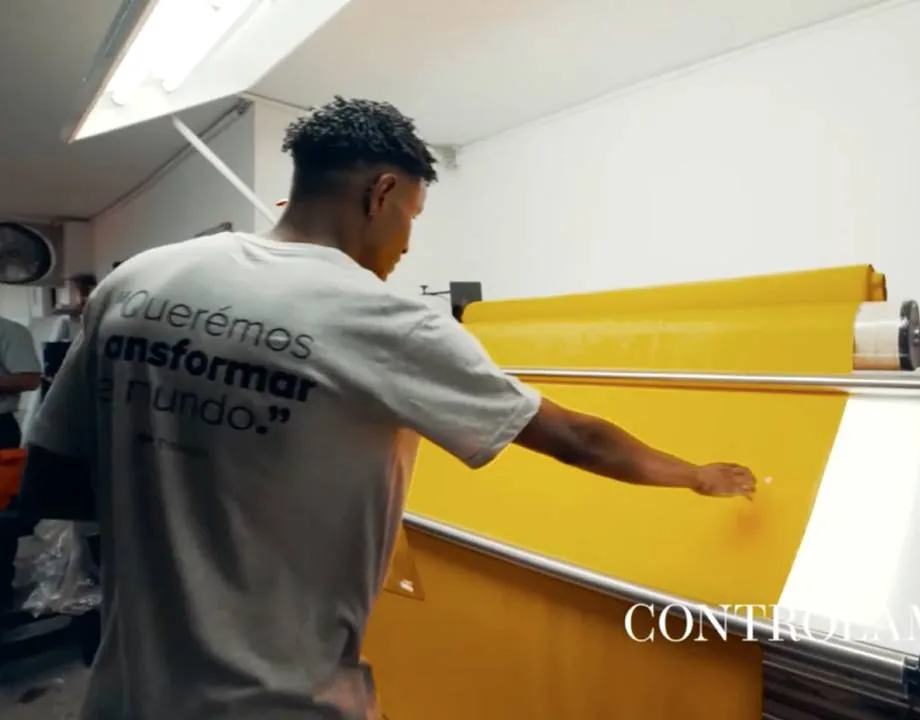
Knit constructions you will hear named in development
Inside the knit family there are several constructions, and each one gives a different garment with its own weight range. They are worth recognizing by name so you can ask for what you mean.
- Jersey is the plain knit everyone knows, the base of the t-shirt, usually around 160 to 220 GSM.
- Pique has a texture of small raised cells, firm and cool. It is the classic polo cloth.
- French terry has a smooth face and a looped back (like a towel) that absorbs sweat, runs around 230 to 250 GSM and is the base of the mid-season sweatshirt.
- Fleece is french terry with the back brushed into a soft pile, thicker and warmer, the core of winter hoodies and crewnecks.
- Rib is a stretchy knit with vertical channels, used at cuffs, collars and waistbands because it stretches and grips.
- Interlock is a double jersey, denser and more stable, identical on both faces, for pieces with better body and for babywear.
How fabric quality is actually judged
Beyond weight, a cloth is judged by how it behaves over time. These are the criteria we check before a fabric is approved for production.
The first is dimensional stability, which in plain terms is shrinkage. Every fabric shrinks somewhat in its first wash and dry cycle, and for natural fibers a 2% to 5% range is considered acceptable, according to fabric dimensional stability testing. More than that and the medium your customer bought turns into a small at home. A properly pre-shrunk cloth holds shape and size wash after wash, and skipping that step is one of the errors that ruins a whole run.
The second is pilling, the little balls that appear from abrasion. Combed cotton and a good anti-pill finish reduce them. Short, cheap yarn multiplies them. The third is colorfastness, meaning the color does not bleed in the wash or fade in the sun, and it is on dark or heavily saturated garments that cheap cloth fails first.
None of the three shows up in a photograph or on a fresh roll. They show up in a garment that has been made and washed. That is why we do not cut a production run without an approved physical sample first, and why every finished order closes with a four-point quality audit.
Same yarn, different finishes
A fiber does not go straight from the loom to the garment. It passes through finishes that change how it behaves. Sanforizing is a mechanical pre-shrink that stabilizes the cloth before it is cut, so the garment no longer shrinks (or shrinks very little) at home. Combing, already mentioned, removes short fibers and leaves a smoother cotton that resists pilling. Mercerizing treats cotton to give it luster, added strength and better dye uptake. Anti-pill treatments cut the fuzzing on cloths that are prone to it. The same fiber, with or without these steps, delivers a different garment, and that detail rarely shows on a fabric quote but is obvious six months into wear.
How to read a fabric spec sheet
When a mill sends you a fabric, the spec sheet carries what you need to decide without guessing. The minimum to look at:
- The composition, with exact fiber percentages (95% cotton, 5% elastane, for example), which sets comfort, stretch and price.
- The weight in GSM, the number you now know how to read.
- The usable width of the roll in centimeters or inches, which together with the pattern decides how far the cloth goes.
- The consumption, or how many meters each garment takes. This is the figure that translates a price per meter into a cost per unit.
- The declared shrinkage, the percentage the supplier stands behind after washing.
That same discipline of writing everything down is what governs the garment spec. If you are heading into production, it helps to have our guide on how to build a tech pack next to you.
Fabric minimums: the dye lot sets your real floor
Most brands assume the minimum comes from sewing. The bottleneck usually sits earlier, in the cloth. Dye houses do not run less than roughly 100 to 200 kilos per dye lot, because every dye bath means setting up and cleaning the machine no matter the volume. Buying below the dye-lot minimum pushes the cost of each garment up by somewhere between 15% and 35%, since that setup gets spread across fewer meters, according to Goodspeed Studio.
That produces material minimums many brands see too late. Stock fabric that is already knitted and sitting in a warehouse can be bought from around 50 to 100 meters. A color made to your specification asks for 200 to 500. A special construction can demand 500 to 2,000. Choosing the cloth moves your minimum more than any other decision, which is why it pays to read how to size your production run before committing to an order.
Sustainability without the green haze
If your brand wants to choose fabric with an environmental criterion, step one is not buying the easy story. Every fiber carries a different cost, and comparing them is not as simple as natural good, synthetic bad. Producing a single cotton t-shirt consumes around 2,700 liters of fresh water, textile dyeing and finishing account for about 20% of global clean water pollution, and one wash of polyester clothing releases up to 700,000 plastic microfibers into the water, according to the European Parliament. Cotton weighs on water and polyester weighs on microplastics. Choosing well means choosing with information rather than with a label.
Recycled content deserves the same care. The "recycled polyester" on most labels comes from PET bottles rather than from used clothing, and true fiber-to-fiber textile recycling still sits below 1% of the world market, with recycled fibers overall reaching just 7.6% of total production, according to the Textile Exchange 2025 report. Worth knowing before you print "recycled" on a hangtag, because recycled cotton and recycled polyester do not mean the same thing, and saying it precisely is part of running an honest brand. We go deeper into that in our playbook on sustainable fashion and responsible manufacturing.
Sourcing fabric in Colombia and what it means for your timeline
There is a factor neither the fiber nor the weight tells you about: supply. The Colombian fashion system is large and well established, but a good share of the yarn is not produced domestically or runs well below demand.
That has a direct effect on your project. In November 2025 the Colombian government decreed zero tariffs on imports of synthetic and cotton yarns and other raw materials for apparel (Decrees 1184 and 1197), precisely because of that supply gap, according to the Presidency of Colombia. For your brand it means the perfect fabric you saw on a mood board may not be available now, or may have to be imported with its own lead time. So we favor domestic cloth when it performs, we go to international sourcing when it does not, and we never quote you a delivery date that depends on a fabric nobody has confirmed yet.
The other factor is the minimum. Mills sell by the meter or by the roll, with their own floors, separate from the garment minimum. We produce from 36 units per style and color, with 100 to 300 as the range where a project runs best on efficiency and cost, and the fabric purchase is calculated exactly for your order. If you are selling into the United States, that supply decision sits inside the wider comparison we lay out in Asia vs nearshore manufacturing. Fabric makes the repeat slower, not faster. Restocking a style is another 30 to 45 business days once the roll is secured, which is why the recommended band sits well above the floor.
How we choose fabric with you
GAT works differently from a catalog. There is no fixed swatch book you pick from, because as product developers we reach many mills and the spectrum is wide. Fabric gets chosen the opposite way round from how most brands expect.
- You tell us the garment and the result you want, or you send a physical reference or a photo.
- You give us your target buying price per unit, which is what narrows the fabric options to your business strategy rather than to a wish list.
- We consult the mills we work with, in Colombia and through international sourcing, and put together a shortlist.
- We approve the final cloth together on a sewn garment sample, and buy exactly what your order needs.
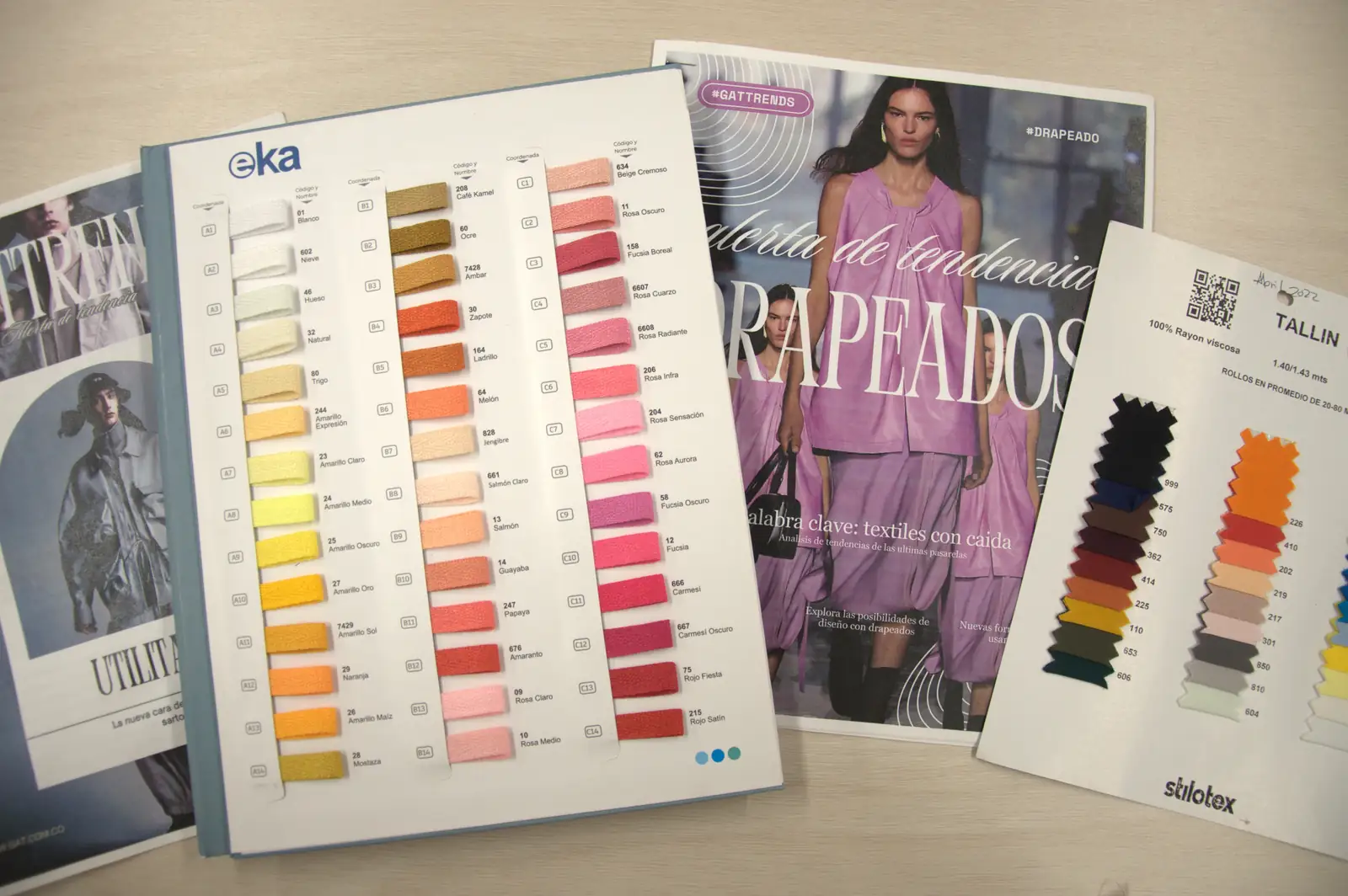
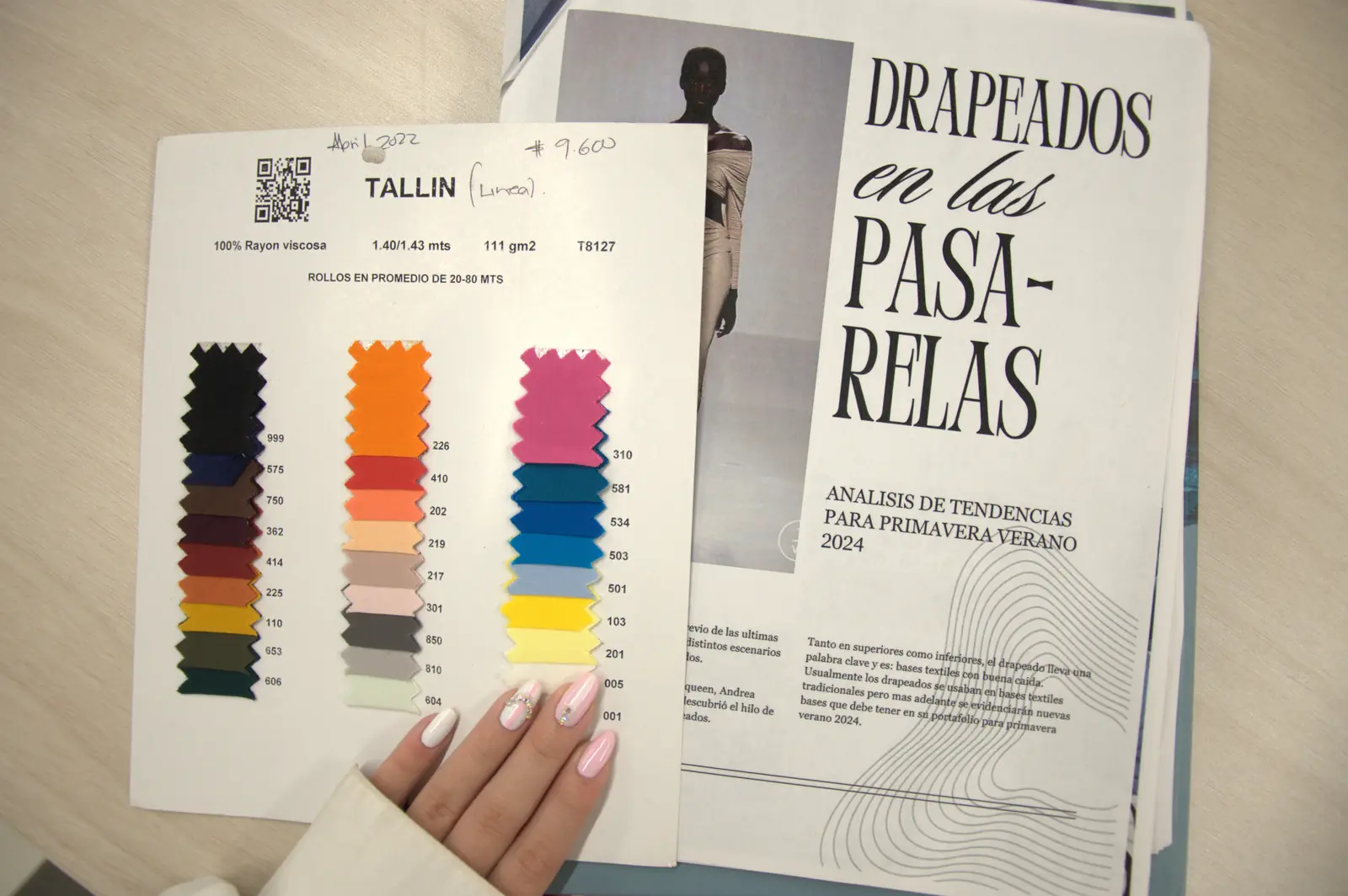
That is why we do not normally ship loose fabric swatches before the garment sample exists. Suppliers work to minimums by the meter or by the roll. If you need to validate the cloth in your hands first, we can arrange a physical fabric swatch, optional and at additional cost. Fabrics, trims, process tests and the sample fitting are all approved by photo, which is how a brand five time zones away keeps control without flying anywhere.
And we are clear about scope. We do not work heavy denim-weight cloth, and we do not work the materials used for structured outerwear such as coats and blazers. If your product lives there, the useful thing is to point you toward a specialist early, before you lose weeks. Everything else happens inside full package clothing manufacturing, where development, sourcing, production and quality control sit with a single point of accountability.
Frequently asked questions about fabric for clothing manufacturing
Do you have a fabric catalog I can choose from?
We do not work from a closed catalog. As product developers we reach many mills, which opens a wide spectrum. We choose the cloth based on what your garment needs and what your target price allows, rather than on what happens to be in a fixed swatch book.
Can I supply my own fabric?
Yes. Sourcing is part of the service, but if you prefer to bring your own fabric or trims we can coordinate it, and sometimes that shortens the timeline. It gets defined during development.
How do I know what GSM to ask for?
Start from the use. Cool, drapey pieces call for light weights around 150 GSM or below, premium everyday garments land near 180 to 200, and warm pieces climb above 280. During development we recommend the weight based on the result and the market you are aiming at.
Cotton or polyester for my brand?
It depends on the garment and the use. Cotton wins on comfort and premium perception for tees and everyday pieces. Polyester and blends win on strength and stability for activewear, uniforms and anything washed frequently. It is rarely all one or all the other, and a large share of garments live in the blend.
Can you source lower-impact fabrics?
Yes, evaluated case by case during development. Since we do not start from a closed catalog, we consult options with the mills we work with based on the use, the durability and the roll availability your project needs. We will tell you plainly when a requested material is not available at your volume rather than promise it.
The right fabric gets defined by working it against your product and your target price, not by picking from a list. Tell us what you want to make and get a free estimate from our quoting tool: with your idea and your budget per unit, we line up the fabric options so your garment makes business sense from the first meter.