

Sustainable fashion and responsible manufacturing are not synonyms, even though marketing treats them as one. Sustainable fashion describes an attribute of the product: the fiber, the dye, how long the garment lasts. Responsible manufacturing describes how it gets produced: the conditions of the people sewing it, the traceability of the chain and, above all, how much material gets wasted before the garment even exists. Confusing the two is the first form of greenwashing, because an organic cotton t-shirt made in lots of ten thousand that nobody buys is not sustainable in any meaningful sense.
This guide is written from the factory's chair. Almost everything published on the subject speaks to the person buying clothes. We are talking to you as the manufacturer that produces for brands, because the decision that weighs most in a garment's footprint gets taken on the floor, before the first meter of fabric is cut. And the conclusion is uncomfortable for a good part of the industry: the single highest-impact move is not overproducing, and it beats any "eco" material. GAT Fashion Lab has spent more than 20 years manufacturing for recognized brands under a full package model, and from that seat we can tell you what is verifiable, what is smoke, and what you can demand of any factory.
How much fashion actually pollutes, and why the 10% figure keeps failing
You will read almost everywhere that fashion produces 10% of global CO2 emissions. That number is not well supported. The two most careful institutional estimates land far below it. The World Resources Institute and the Apparel Impact Institute, working from industry data, put apparel emissions at 1.025 gigatonnes of CO2 equivalent in 2019, roughly 2% of global annual greenhouse gas emissions, in their Roadmap to Net Zero. McKinsey and the Global Fashion Agenda, using 2018 data and a wider boundary, arrived at 2.1 billion tonnes, about 4% of the global total. The Geneva Environment Network reports the honest range as 2% to 8%, which reflects a real methodological problem: there is no single agreed boundary for what counts as "the fashion industry".
The sector still has a large problem, and the end-of-life link is where it shows worst. Less than 1% of the material used to make clothing is recycled back into new clothing, and around 73% of the material in clothing production ends up landfilled or incinerated, the equivalent of a garbage truck of textiles burned or buried every second, according to the Ellen MacArthur Foundation. If recycling solves so little, the real lever sits earlier, in producing less and producing better. Using the rigorous range instead of the myth is also the first test of whether a factory inflates numbers to sell you comfort.
The sustainability act that weighs most: not overproducing
Overproduction is the root of the problem, and it gets corrected by making exactly what will be sold. Changing fabric does not fix it. Every style produced above real demand is a garment nobody asked for, and multiplied across thousands of styles a year it becomes mountains of clothing made for nothing.
The scale is documented. The world makes somewhere between 80 and 150 billion garments a year, and between 8 and 60 billion are never sold, with the Ellen MacArthur Foundation putting the annual value of discarded, unsold inventory at around US$500 billion, as reported by The Interline. That inventory does not vanish. It gets marked down, warehoused, exported as surplus or destroyed.
This is where the factory's business model decides the impact. A high minimum order quantity forces a brand to make more than its real demand justifies, and that excess ends up in discount or in a warehouse. Which makes a low minimum an environmental decision as much as a commercial one. At GAT the floor starts at 36 units per style and color, though for the costs to work properly we recommend between 100 and 300 per design, with flexible volumes above that for programs that need them. Producing in lots that track demand, replenishing what actually rotates and not filling a warehouse with leftovers is the least glamorous and most effective form of responsible manufacturing there is. If you are working those numbers out, the playbook on how many units to produce takes it down to arithmetic.
Cutting waste before it exists
The cheapest waste to manage is the waste that never gets generated. There are two fronts where a factory prevents it at source, before the garment exists at all.
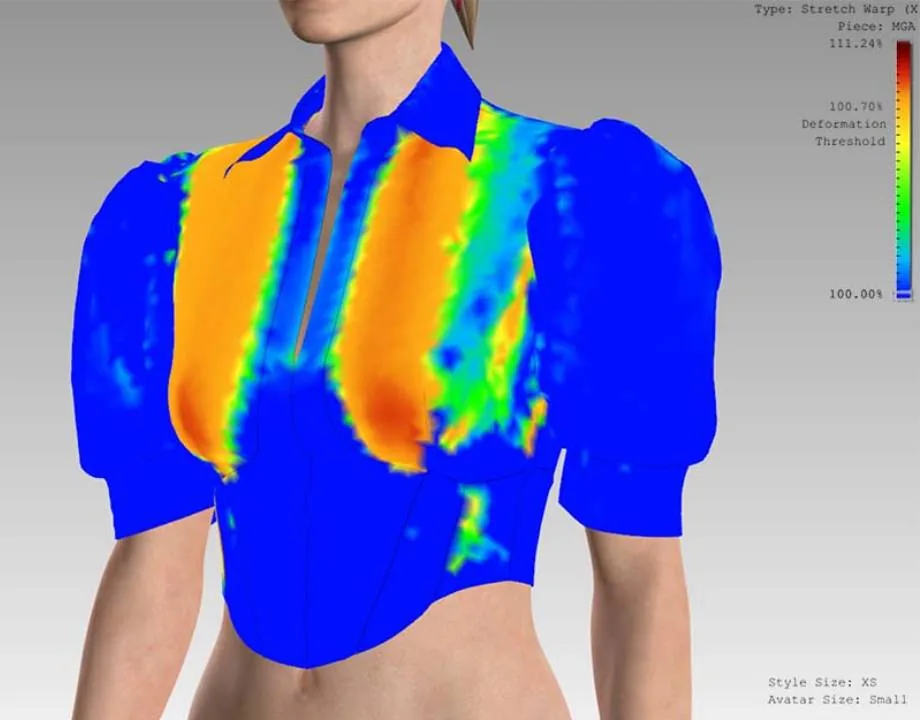
The first is sampling. Physical sampling represents between 10% and 15% of total production cost, and a good share of those samples never gets used. Digital 3D sampling cuts physical samples by 80% to 90% and reduces the material waste tied to prototyping by around 30%, according to Textile World, which reports that Adidas eliminated close to 40% of its physical samples and Tommy Hilfiger cut its sample production by 80%. Fewer samples means less fabric cut, fewer international shipments back and forth and fewer approval rounds. We work with digital and 3D prototyping precisely so a project reaches approval with few physical samples, and we do not cut a run until you have approved the final physical sample.
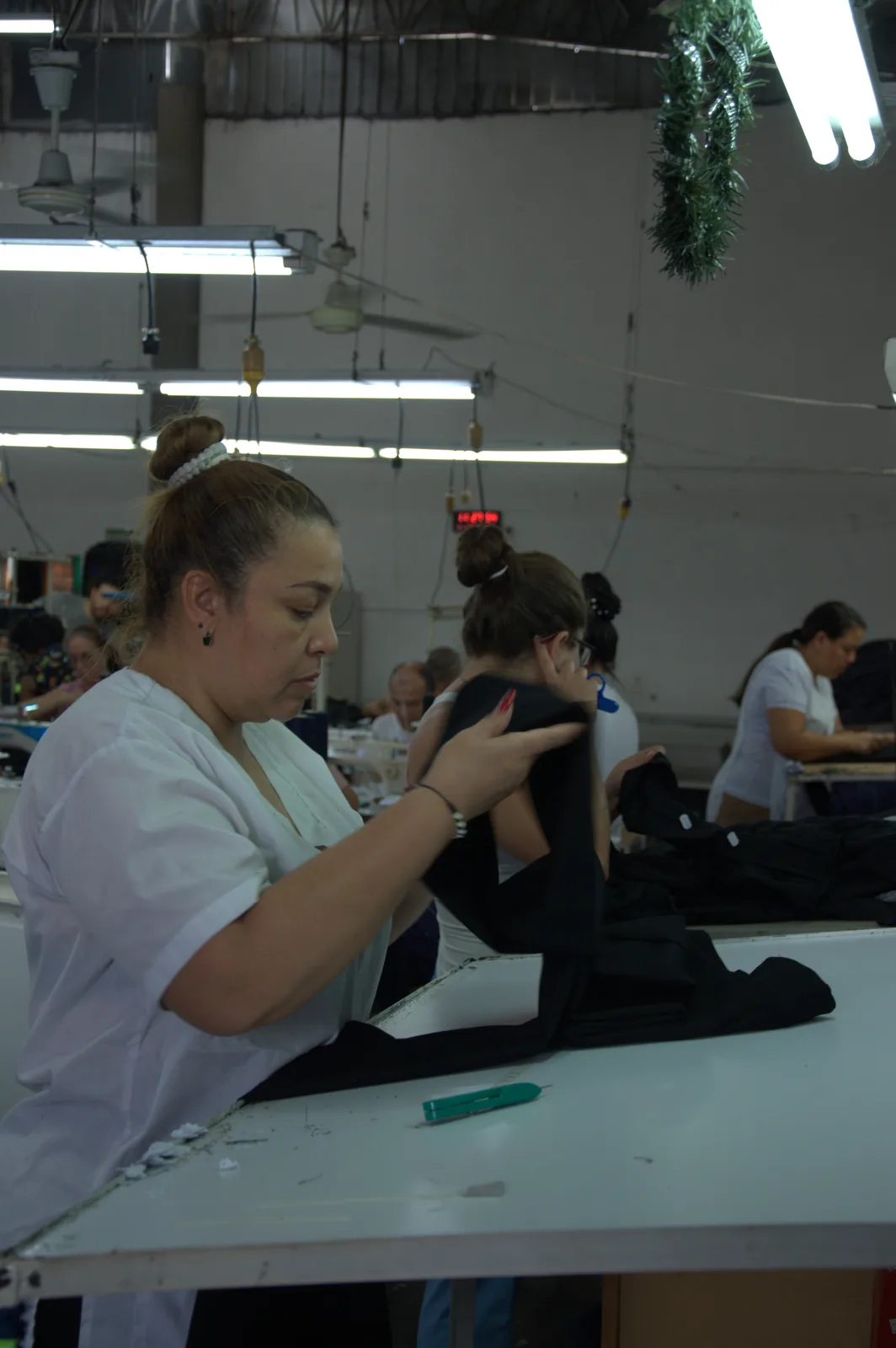
The second front is cutting. An enormous share of a factory's waste is born on the cutting table, where a badly built marker leaves offcuts that go in the bin before anything gets sewn. Marker optimization, cutting efficiency, correct size grading and offcut management are real technical work, and they separate a plant that looks after material from one that throws it away. Choosing the fabric well also cuts that waste, because a standard cloth with available rolls yields more than an indulgent development. On that, our fabric guide helps you ask for materials that actually perform.
Producing close to your market as an environmental decision
The sourcing pendulum in apparel is swinging back toward production near the selling market. A report by AlixPartners attributes that to tariffs, freight costs and geopolitical risk, and identifies Colombia as an emerging hub: the same time zone as the United States for real-time coordination, a skilled technical workforce, free-trade zones and incentives, with higher value-added exports projected to grow 11% in 2025.
Producing close is environmental and commercial at once, without having to choose. On the environmental side, less distance between the factory and the market means a smaller transport footprint. On the operational side, shorter lead times and the ability to replenish what is selling, instead of importing a container every six months and hoping. And on the social side there is something production ten thousand kilometers away cannot give you: the real ability to audit conditions, because you can visit the plant and see who sews your clothes. We manufacture in Colombia and export actively to Central America, the Caribbean and the United States, so if you sell abroad the proximity works in your favor. That side is covered in GAT International, and the fuller comparison in Asia vs nearshore manufacturing.
Living wage: the social part that can actually be verified
Responsible manufacturing collapses if the low price is being funded by paying people badly. The average gap between the legal minimum wage and a living wage across 28 garment-producing countries was 49.5% in 2024, a point worse than in 2023, according to The Industry We Want, reported by Business of Fashion. Translated: the person sewing receives on average only 55% of what a dignified life requires. On average barely 4% of a garment's price reaches the wage of the person who sewed it, and only 1% of large brands disclose how many workers in their chain receive a living wage.
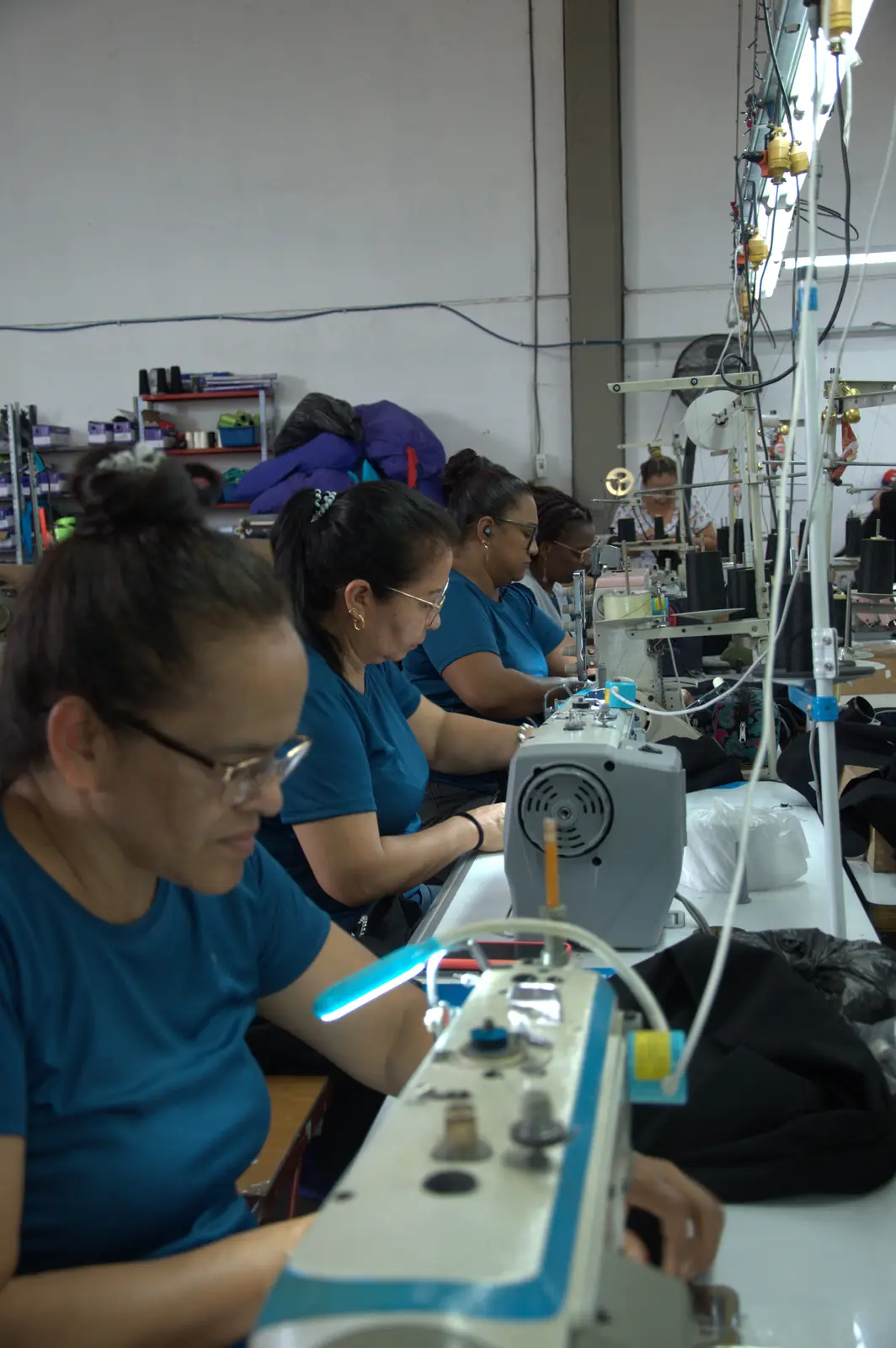
Against that backdrop, the social side stops being a brand ornament and becomes a verifiable difference. What we do inside our own operation is concrete: our team is mostly women, 47% of the women who work with us are heads of household, 2% are part of the LGBTIQ community, we hold zero tolerance for harassment and discrimination, we prohibit forced and child labor, and we comply fully with Colombian labor law including occupational health and safety obligations. We require the same dignified employment conditions of our suppliers, because a chain is only as responsible as its weakest link. You can see how that translates into real production in our customer cases.
Responsible materials and their honest limits
Recycled fibers, better-origin cotton and recycled polyester have their place, but an "eco" material does not make a garment sustainable if it was overproduced. Recycled polyester made in excess and sold at 50% off carries more footprint than a conventional one produced to actual demand. Material helps. It does not decide the outcome.
So we prefer to talk to you precisely about what each project needs rather than sell you a closed catalog of green fabrics. If your collection requires lower-impact materials, we evaluate them case by case during product development and consult options with the mills we work with, based on the use, the durability and the roll availability. And a garment that lasts three years and washes well weighs more on the environmental balance than whichever fiber is fashionable this season.
How not to greenwash, in practice
Greenwashing stopped being only a reputational problem and became a legal one, with dates attached. In the European Union, Directive (EU) 2024/825 on empowering consumers for the green transition bans generic environmental claims such as "eco-friendly", "green" or "climate neutral" without verifiable evidence, and bans sustainability labels that are not based on an approved certification scheme or set by a public authority. It entered into force in March 2024, member states had to transpose it by March 2026, and it applies from 27 September 2026, according to the European Commission's own guidance. The more specific Green Claims Directive proposal is a separate matter and its future is unsettled, since the Commission signalled in mid-2025 that it intended to withdraw the proposal, as tracked by Latham and Watkins. Directive 2024/825 stands regardless.
Enforcement is not theoretical either. The UK Competition and Markets Authority opened an investigation into ASOS, Boohoo and George at Asda over vague sustainability claims, and the case closed in March 2024 with formal undertakings from all three to use only accurate and clear green claims, as summarized by Peters and Peters. In the United States the picture is different: the Federal Trade Commission's Green Guides still date from 2012, a revision has been under consideration since 2022, and no updated version has been issued, which you can check on the FTC's Green Guides page. Less regulation does not mean less risk, because the market checks anyway.
Consumers do not swallow claims whole. In 2024 shoppers said they were willing to pay on average 9.7% above price for sustainable products, according to the Simon-Kucher global sustainability study, but a large share research the claim themselves before believing a brand. The mechanics for not falling into it are boring and they work:
- Back every claim with a figure and a source anyone can check. A percentage with no origin is only a promise.
- Avoid the vague terms the new regulation now pursues. "Conscious" does not mean anything measurable.
- Talk about what you genuinely control and admit what you do not. Limits stated well build more trust than an inflated badge.
We apply that rule to ourselves. We do not hold formal certifications such as ISO or fair-trade seals, and we do not publish environmental metrics we cannot back with a verified source. We would rather tell you what we do, with data, than hang a label on the wall that we have not earned.
Certifications: which ones actually mean something
Not every seal carries the same weight. GOTS, the Global Organic Textile Standard, certifies organic fiber content and traceability along the chain. OEKO-TEX Standard 100 certifies that the garment is free of substances harmful to skin. They are among the few that audit something concrete. In Colombia, Inexmoda runs a sustainability route with three certification levels to help companies in the sector measure their progress. A seal is useful when it states exactly what it covers and who audits it. One that cannot explain either of those two things is marketing.
The useful question goes past "do you have certifications?" and lands on "which ones, and what exactly do they cover?". An honest manufacturer will tell you what it has and what it does not, without inflating. Anyone promising you every seal in the world without being able to show them is telling you something.
End of life, and the EU rules that now have dates
The regulation that most directly targets overproduction is already scheduled. From 19 July 2026 the EU's Ecodesign for Sustainable Products Regulation prohibits large companies from destroying unsold clothing, clothing accessories and footwear, requiring resale, donation or preparation for reuse first. Medium-sized companies are covered from 2030, small and micro enterprises are exempt, and companies must document what they discard and publish an annual report, keeping records for five years. The Commission estimates that 4% to 9% of unsold textiles in Europe are destroyed each year before ever being worn, generating roughly 5.6 million tonnes of CO2, according to the European Commission.
Extended producer responsibility for textiles pushes the same way, making brands accountable for the end of life of what they put on the market. But while fiber-to-fiber recycling still resolves under 1% of the material, the immediate lever remains producing to the size of demand so that fewer garments reach that stage at all. Circularity starts on the factory floor, not in the recycling bin.
What to ask your manufacturer
Whether or not you work with us, this list measures the real sustainability of any factory. Be wary of vague answers and always ask how they can prove it.
- Is your team formally employed, with documented social security contributions? Labor informality is the number one warning sign.
- Do you comply with the country's labor law on hours, benefits and workplace safety?
- How do you prevent harassment and discrimination? A written policy is worth more than a promise.
- Do you require the same conditions of your own suppliers?
- What is your minimum order quantity, and why? A minimum that is too high forces you to overproduce.
- Do you use digital prototyping to reduce physical samples before cutting?
- How do you handle offcuts and waste from the cutting table?
- Can you source lower-impact fabrics when a project calls for them?
- Do you hold certifications? Which ones, and what exactly do they cover?
The last question is the most revealing. Transparency about limits is itself a sustainable practice. If you want to settle the production model before you contract anyone, compare a clothing factory against a full package service: a workshop only sews what you hand over, while full package takes on development, sourcing and quality control, which gives you more points where responsible practice can be required and verified.
Frequently asked questions about sustainable clothing manufacturing
What is the difference between sustainable fashion and responsible manufacturing?
Sustainable fashion describes an attribute of the product, meaning the material, the fiber, the durability. Responsible manufacturing describes how it gets produced: labor conditions, chain traceability and the waste avoided before anything is cut. A product with an "eco" material made in excess is not sustainable, so the two go together or they do not go at all.
Is fashion really 10% of global emissions?
Not with that precision. The 10% figure is not well supported. The World Resources Institute and the Apparel Impact Institute put apparel at around 2% of global greenhouse gas emissions, McKinsey and the Global Fashion Agenda at about 4%, and the honest published range is 2% to 8%. The sector still has a large impact, mainly through waste and overproduction.
What can a manufacturer actually control to produce responsibly?
More than it seems. A factory controls the minimum order quantity, which decides whether you are forced to overproduce, the digital sampling that avoids physical samples, cutting efficiency and offcut management, the labor conditions of its own team and the ones it requires of suppliers. All of that happens before the garment exists, which is where most of the footprint is decided.
Does GAT hold environmental or fair-trade certifications?
Not today, and we say so plainly. What backs us is the track record manufacturing for recognized brands, compliance with Colombian labor and environmental law, the four-point quality audit, digital prototyping to reduce samples, and the approved physical sample before anything goes into production. We would rather show you verifiable practice than an empty seal.
Can I request lower-impact fabrics for my collection?
Yes. Lower-impact material requirements are evaluated case by case during development. Since we do not start from a closed catalog, we consult options with the mills we work with based on what your project needs in use, durability and availability, and we tell you when something is not achievable at your volume.
Does producing smaller runs really reduce environmental impact?
It is the most direct lever a brand has. Unsold garments carry the full footprint of production with none of the sale, and between 8 and 60 billion garments a year are never sold. Producing to the size of real demand and replenishing what rotates avoids that footprint entirely, which no fiber substitution can match.
Producing with an ally that treats its people well, does not force you to overproduce and tells you the truth about what it does is part of building a brand that lasts. That is how we approach clothing manufacturing end to end. When you have your tech pack, or even just a reference image, get a free estimate from our AI quoting tool and you will have a figure in minutes.