
An apparel manufacturing glossary is the vocabulary that appears the moment you stop designing a garment and start producing one, from MOQ to Incoterms, explained so you know exactly what you are agreeing to when a factory uses the word. Making clothing has its own language, and not speaking it costs money: a term misunderstood in a spec sheet gets manufactured at scale with the mistake included. These are the words that carry the most weight, defined by the people who cut and sew.
We write this from inside a large, established industry, the Colombian fashion system. GAT Fashion Lab has spent more than 20 years manufacturing for recognized brands in Colombia and abroad under a full package model. So this glossary gives you the reasoning behind each term as well as the definition, and it flags the places where the same idea travels under a different name in English and Spanish, which is where most brands working with a Latin American factory lose time.
Quantities and minimums: what MOQ means and why it exists
Style, and the word "reference". Each individual design is a style, and the minimum applies per style and per color. Five colorways of the same tee are five separate minimums, because each one needs its own fabric spread, its own cut and its own quality check. If you work with a Latin American factory you will hear the Spanish word referencia used for exactly this, and quotes will often be broken down per reference. Same unit, different word.
MOQ (minimum order quantity). The lowest number of garments a manufacturer will produce per style. It exists because of economies of scale: mounting a fabric, calibrating machines and preparing a marker costs about the same for 30 garments as for 300, so below a certain point the cost per unit climbs sharply. Minimums vary enormously by factory, with small workshops taking short runs and large plants asking for several hundred units per style. At GAT we produce from 36 units per style and color, with 100 to 300 as the recommended range for the numbers to work, and no ceiling above that. Before you commit, it is worth reading how to size your production run.
MOQ connects to a bigger problem: overproduction. The world makes somewhere between 80 and 150 billion garments a year, and between 8 and 60 billion are never sold. The Ellen MacArthur Foundation puts the annual value of discarded, unsold inventory at US$500 billion, as reported by The Interline. A low minimum and production sized to demand are the direct antidote: you make what you can sell instead of filling a warehouse with sizes nobody wanted.
Manufacturing models: from CMT to full package
Cut and sew. Producing a style from scratch, cutting and sewing the garment from flat fabric using your own patterns, rather than starting from a finished base garment. It is the opposite of customizing a blank: here the pattern, the fabric and the construction are yours.
CMT (cut, make, trim). The international name for what Spanish-speaking factories call maquila. The brand supplies the fabric, the patterns and the sourcing, and the workshop supplies the machines and the hands. It works if you arrive with everything developed, and it leaves you stranded if you do not. We break the model down in CMT manufacturing.
Blanks and private label. Blanks are ready-made unbranded garments (tees, hoodies, tanks) that you buy to print or embroider your logo onto. Private label is the same road: you put your brand on a product the manufacturer already carries in its catalog. It is the fast, low-risk route, though it limits your design to what already exists. The market confirms it as a serious business: blanks are projected to grow from US$15.6 billion in 2025 to US$25.9 billion in 2035, with tees and tanks making up close to 49% and the B2B channel around 69%, according to Future Market Insights.
Full package (FPP, full package production). One supplier covers the whole road from idea to a garment ready to sell: design and development, fabric and trim sourcing, patternmaking, production, quality auditing and logistics, with a single point of accountability. The difference from CMT is commercial as much as technical, because it decides how much control and how much risk your brand carries. Under CMT you carry the development and the mistakes. Under full package the manufacturer does. It is the model GAT works with, and we develop it in full package clothing manufacturing.
| Model | Who supplies the fabric | Who does patterns and development | Who audits quality |
|---|---|---|---|
| CMT | The brand | The brand | The brand |
| Private label | The manufacturer | The manufacturer, from catalog | The manufacturer |
| Full package (FPP) | The manufacturer | The manufacturer | The manufacturer, with its own audit |
If you are torn between having someone sew what you already developed and handing the whole thing to a single point of accountability, the longer comparison lives in clothing factory vs full package service. And if what you are missing is exactly the design and pattern stage, that lives in fashion product development.
The tech pack: the blueprint that prevents wrong samples
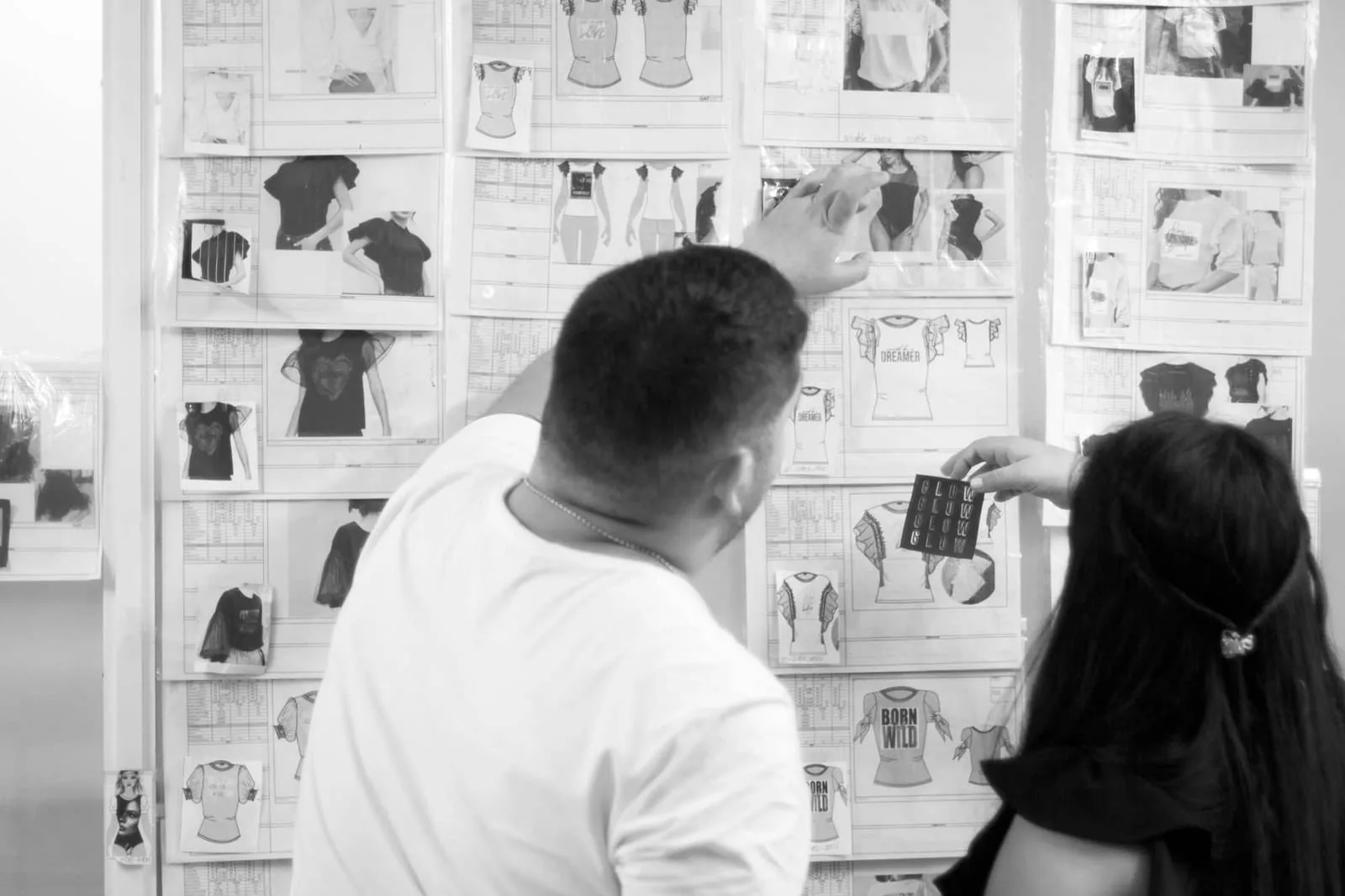
Tech pack (spec sheet). The document carrying every specification needed to make the garment: fabrics, trims, a measurement chart, tolerances, processes and construction. The golden rule is that everything must be measurable. Pantone 19-4052 TPX rather than "nice blue", 180 GSM rather than "soft fabric", because anything ambiguous gets resolved by the workshop's own judgment and it almost never matches yours. The most expensive and most common error is failing to update the spec after fitting changes, because bulk production then goes out with the old version and that run is on you. If you are building yours, we have a full guide on how to build a tech pack.
POM (point of measure). Each exact place the finished garment is measured, such as chest width one inch below the armhole or full length from the high point of the shoulder, with its value and its tolerance. It is what turns "make it fit well" into something verifiable with a tape measure.
Tolerance. The accepted margin between the spec measurement and the real garment, for example plus or minus half an inch on a length. Fabric moves as it is sewn, so without a declared tolerance every garment would be "wrong", and with a sensible tolerance the run comes out consistent.
BOM (bill of materials). The inventory of every material in the garment: body fabric with its composition and weight, linings, interfacing, thread, ribbing, and every trim from buttons to drawcords. Each material carries its own purchase minimum, so a clear BOM also flags your sourcing bottlenecks before they turn into delays.
Patterns, grading and construction finishes
Patternmaking. Developing the templates the fabric is cut against. At GAT it is 100% digital, and the editable files become your property once the development is paid in full. A well-made base pattern is the difference between a garment that fits and one that hangs crooked no matter how good the cloth is.
Grading. Taking that base pattern, normally developed in a size M, and stepping it through the rest of the size run. It is not scaling everything up or down evenly, because each point grows differently. Bad grading produces sizes that fit strangely and wastes fabric in the cut, two costs that only appear once you are in production.
Marker. The layout that arranges every pattern piece across the fabric before cutting, positioned to use as much of the roll as possible. A good marker is one of the quietest cost savings in the whole process, and a bad one shows up as waste you paid for.
Sewing has its own vocabulary of finishes, and recognizing it helps you ask for what you actually want. Overlock is the stitch that finishes internal edges so the fabric does not fray. Flatlock is the flat, elastic seam typical of activewear, which does not rub the skin. Rib is the channeled, stretchy knit used at cuffs, collars and waistbands. Bias binding is a strip of fabric cut on the diagonal to finish curves such as necklines and armholes. Interfacing is the internal reinforcement that gives structure to collars, cuffs and waistbands. And SPI, stitches per inch, measures seam density, where more stitches usually mean a stronger, cleaner join.
Fabric, fibers and GSM: why more weight is not more quality
Combed vs carded cotton. Combed cotton goes through an extra process that strips out the short fibers and leaves a smoother, softer, stronger yarn. Carded cotton skips that step, so it is cheaper and slightly rougher. On a premium tee, combed is noticeable in the hand and in how the garment survives washing.
Among the constructions you will name most often are jersey (the light, stretchy knit of the classic tee), french terry (looped on the inside, the base of mid-weight sweatshirts and hoodies), pique (the textured knit of polos) and polyester with its blends, which bring strength, quick drying and, critically for printing, affinity with sublimation. Choosing fabric deserves its own study, and we have one in the fabric guide for clothing brands.
GSM (grams per square meter). How much one square meter of fabric weighs, usually expressed in the US as ounces per square yard. It exists to compare densities: a summer tee sits around 140 to 170 GSM and a warm winter garment climbs to 200 to 260. Now the myth worth taking apart. More GSM is not more quality. A 180 GSM garment made with good cotton and good finishing can outlast a 240 GSM one without those processes. Durability comes from the combination of yarn type, combing, stitches per inch and finishing, not from the number on the label.
Dimensional stability. Whether the fabric holds its measurements after washing and drying. It gets verified with named laboratory methods, principally AATCC Test Method 135 for home laundering and ISO 5077 for dimensional change, and it is the difference between the medium your customer bought and the small they end up with. You can see the current method list at AATCC.
Decoration decoded: sublimation, DTF, DTG and screen printing
Four techniques dominate garment decoration, and choosing wrong either raises the cost or ruins the result. The most useful rule to remember: sublimation only works on polyester, while DTF goes onto almost any fabric.
| Technique | Works on | Best for |
|---|---|---|
| Sublimation | Polyester only, or high polyester content | Full-color and all-over designs, activewear |
| DTF, direct to film | Almost any fabric, cotton included | Small runs, many colors, dark fabric |
| DTG, direct to garment | Mostly cotton | Photographs and gradients on cotton |
| Screen printing | Almost any fabric | High volumes with few flat colors |
The numbers explain why DTF is on everyone's lips. Its global market was estimated at US$2.72 billion in 2024 and is projected to reach US$3.92 billion by 2030, growing about 6% a year, according to Grand View Research. Sublimation, meanwhile, led digital textile printing with 52.5% of revenue in 2024 inside a US$5.8 billion market, resting precisely on polyester as its main substrate, according to Grand View Research. Screen printing still owns high volumes with few colors, and DTG is the ally of photographic artwork on cotton in short runs.
Decoration also moves your minimum. DTF, digital printing and sublimation carry no process minimum of their own, so a tee can reach the 36-unit floor. Screen printing and embroidery involve setup that only makes sense at higher counts, in the order of 100 units per style, and that is a detail worth settling early rather than discovering inside a quote.
Samples and prototypes: from proto to PPS
Sample. The first real garment made with the final materials and processes, so you can approve it before producing at volume. It becomes the standard the whole run is measured against, and at GAT no production starts without one.
Fit sample. The sample made specifically to check fit and measurements on a model or dress form. The adjustments that come out of it have to go back into the tech pack, or production will repeat the same problem.
PPS (pre-production sample). The final sample, with every correction applied, approved right before the production order is released. It is the definitive sign-off, and what comes out in the PPS is what should come out across the entire run.
Counter-sample. A sample built from patterns, specs or garments that already exist, in order to reproduce or adjust a design. It is the cheapest scenario, because you arrive with almost everything defined and the manufacturer reproduces it.
Fabric swatch, also called a hanger. A physical piece of the chosen fabric, sent so you can validate it before the full yardage is bought. It is optional and quoted separately, and it saves you from buying hundreds of meters of the wrong cloth.
Fitting. Trying the sample on a model or form to confirm that fit and measurements match what was approved. At GAT it is documented with standardized photos and a measurement report, which is how a brand in another country signs off without traveling.
Measurements, adjustments and quality control
There are two measurement charts people confuse, and the distinction matters. The garment measurement chart holds the dimensions of the finished clothing by size, and that is what the manufacturer guarantees. The body measurement chart holds the measurements of the person who will wear it, and it is useful to validate fit, but the two are not the same and should not be crossed.
On adjustments, a minor adjustment is a small correction that does not require redoing the pattern, buying materials or making another garment, and at GAT up to two are included at no cost during development. A major adjustment is a structural change such as a pattern redesign, a silhouette change or a change to raw materials already purchased, and it gets quoted separately.
AQL (acceptable quality limit). The statistical standard used to inspect a finished lot, meaning how many garments get pulled from the run and how many defects are tolerated before the lot is rejected. The sampling plans behind it are published as ISO 2859-1, and branded apparel programs commonly work to an AQL of 2.5 for major defects. At GAT, quality is audited at four points of the process against the approved sample: 100% of incoming fabric, the cut, construction from start to finish, and a final audit before dispatch. Checking only at the end is checking when it is already too late to fix anything.
Production timelines: why a collection takes months, not weeks
A garment travels through several phases before it reaches your warehouse: sampling, cutting, assembly, decoration, quality control and packing. Each has its own duration, and adding them up explains why a serious project does not resolve in two weeks. A full package built from zero, with development, fabric sourcing, approved samples and production, tends to take in the order of 25 to 27 weeks or more, and it is worth being suspicious of anyone promising much less, because it almost always means skipping development or skipping sample approval, which is exactly where the expensive mistakes get caught.
Within that, the execution windows we work to are development in 2 to 8 weeks and production in 30 to 45 business days. What moves the schedule most is fabric and trim sourcing, meaning whether the material is already in stock, has to be shipped in, or has to be made. Every project is different, and we have met demanding deadlines before, including samples in under a week and 5,000 garments in under 28 days.
Export, duty and delivery: Incoterms and rules of origin
Incoterms, published by the International Chamber of Commerce, define how far the manufacturer delivers and who absorbs each cost along the way. Three come up most often:
- EXW, ex works: you receive the goods at our facilities in Colombia and arrange transport from there.
- FOB, free on board: the goods are delivered cleared for export and loaded at the port of origin.
- DDP, delivered duty paid: the goods arrive at your address with freight and import charges already paid.
Rules of origin and "yarn-forward". This is the term that decides whether your import pays duty. Under the United States-Colombia Trade Promotion Agreement, apparel made in Colombia enters the US duty free when it meets a yarn-forward rule of origin, meaning the yarn spinning, the fabric formation and the garment assembly all happen in the United States or Colombia. There is a de minimis allowance of up to 10% by weight for fibers or yarns from outside the region, a short supply list for materials not commercially available regionally, and no tariff preference level caps, according to the International Trade Administration and USTR. Worth knowing before you assume any garment made in Latin America is automatically duty free, because it is the origin of the yarn and the fabric, not the address of the sewing floor, that decides.
Landed cost. The real cost of a garment at your warehouse door, which is the unit price plus freight, insurance, duty, brokerage and any import charge. Apparel is one of the most heavily tariffed categories entering the United States, with an average effective rate the American Apparel and Footwear Association puts at more than five times the average across all US imports, so comparing suppliers on unit price alone leaves out the number that actually matters. We quote production EXW at our facilities in Colombia and give you an estimate of freight, duties and taxes before you start, with the caveat that these are estimates and can change at the moment of import, since they are set by each country and by the parties that intervene. DDP is available when it is agreed up front. How we support that route is covered in GAT International.
Nearshore and offshore manufacturing: where the words come from
You will hear "offshore manufacturing" for production placed far from the selling market, typically in Asia, and "nearshore manufacturing" for production placed in a nearby country in the same or an adjacent time zone. For a US brand, nearshore usually means Mexico, Central America, the Caribbean or Colombia. The terms describe geography rather than quality, and neither one guarantees anything on its own. What changes with proximity is concrete: how fast a sample round closes, how quickly you can reorder a style that is selling, and whether you can get an answer inside the same working day. We compare the two honestly, including when Asia is the better call, in Asia vs nearshore manufacturing.
Frequently asked questions about apparel manufacturing terms
What is the difference between a sample and a counter-sample?
A sample is developed from scratch, with new patterns, fabrics and processes. A counter-sample reproduces a design that already exists, from patterns or specs you already own, so it is usually cheaper and faster.
Does high GSM guarantee a better garment?
No. GSM measures weight, not quality. A 180 GSM garment in good combed cotton with proper finishing can outlast a 240 GSM one without those processes. Durability comes from the combination of fiber type, stitches per inch and finishing.
When should I use sublimation and when DTF?
Sublimation only works on polyester and is ideal for full-color or all-over designs in activewear. DTF goes onto almost any fabric, cotton included, and performs better on small runs, with many colors, or on dark fabric.
What MOQ should I expect from a manufacturer?
It depends on the factory. Small workshops take short runs and large plants ask for several hundred units per style. At GAT we produce from 36 units per style and color, with 100 to 300 recommended for better efficiency and cost, and thousands of units per style when that is what a program needs.
Why does my manufacturer want such a detailed tech pack?
Because anything left ambiguous gets decided by the workshop's own judgment. "Nice blue" is open to a thousand readings. Pantone 19-4052 TPX defines the exact color. A measurable tech pack is what makes the sample and the production come out the way you imagined, and it is the cheapest insurance you can buy against rework.
Can I visit the factory before I commit?
Yes. You are welcome at our offices in Cali, Colombia, where you can meet the team and see real product, and we coordinate the visit with you. Every project also starts with a physical sample you approve before anything goes into production.
You have the language now. Put it to work with people who actually manufacture: get a free estimate from our AI quoting tool and we will walk your project from idea to a garment ready to sell. If you want to see who we work with, our customer cases are the place to start.