
The minimum order quantity (MOQ) for clothing is the lowest number of units a manufacturer will produce per style, where a style means each design in each color. At GAT it starts from 36 units per style and color, and we recommend between 100 and 300 for the development to amortize properly, with no ceiling above that. The number is not arbitrary. It exists because there are setup costs (pattern, marker, machine changeover and fabric purchase) that get paid whether you make 36 garments or 3,000, and that setup gets divided across fewer garments the smaller the order.
To calculate yours, cross three things: the minimum the factory imposes and, above all, the one the fabric imposes, the break-even math of your own business, and your real rate of sale. The rest of this playbook gives you the arithmetic, the ranges by garment type and by type of manufacturer, and the budgeting mistake almost everyone makes, which is believing the MOQ is "50 units" when it actually multiplies by every color. If your design is already settled, you can go straight to a quote for full package clothing manufacturing at your volume.
Why the minimum exists: the math of spreading setup
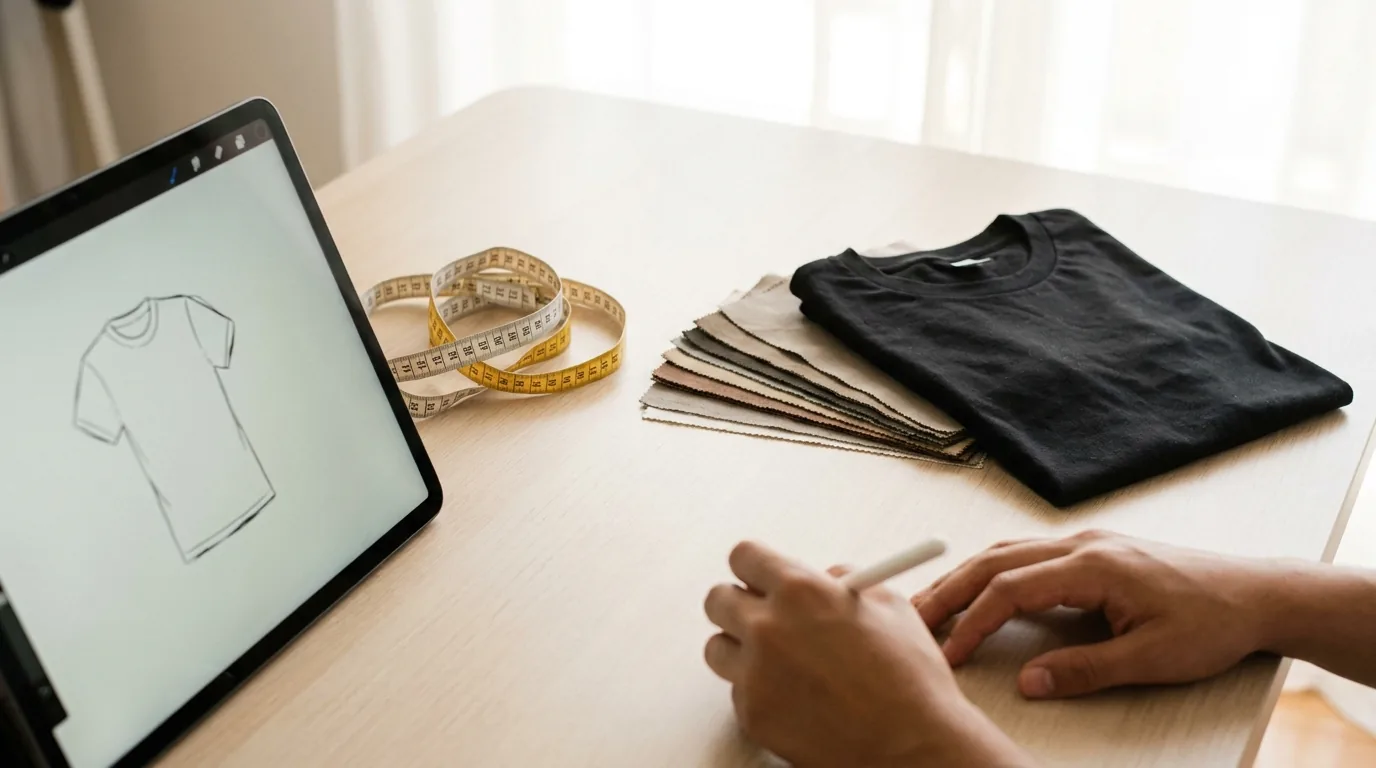
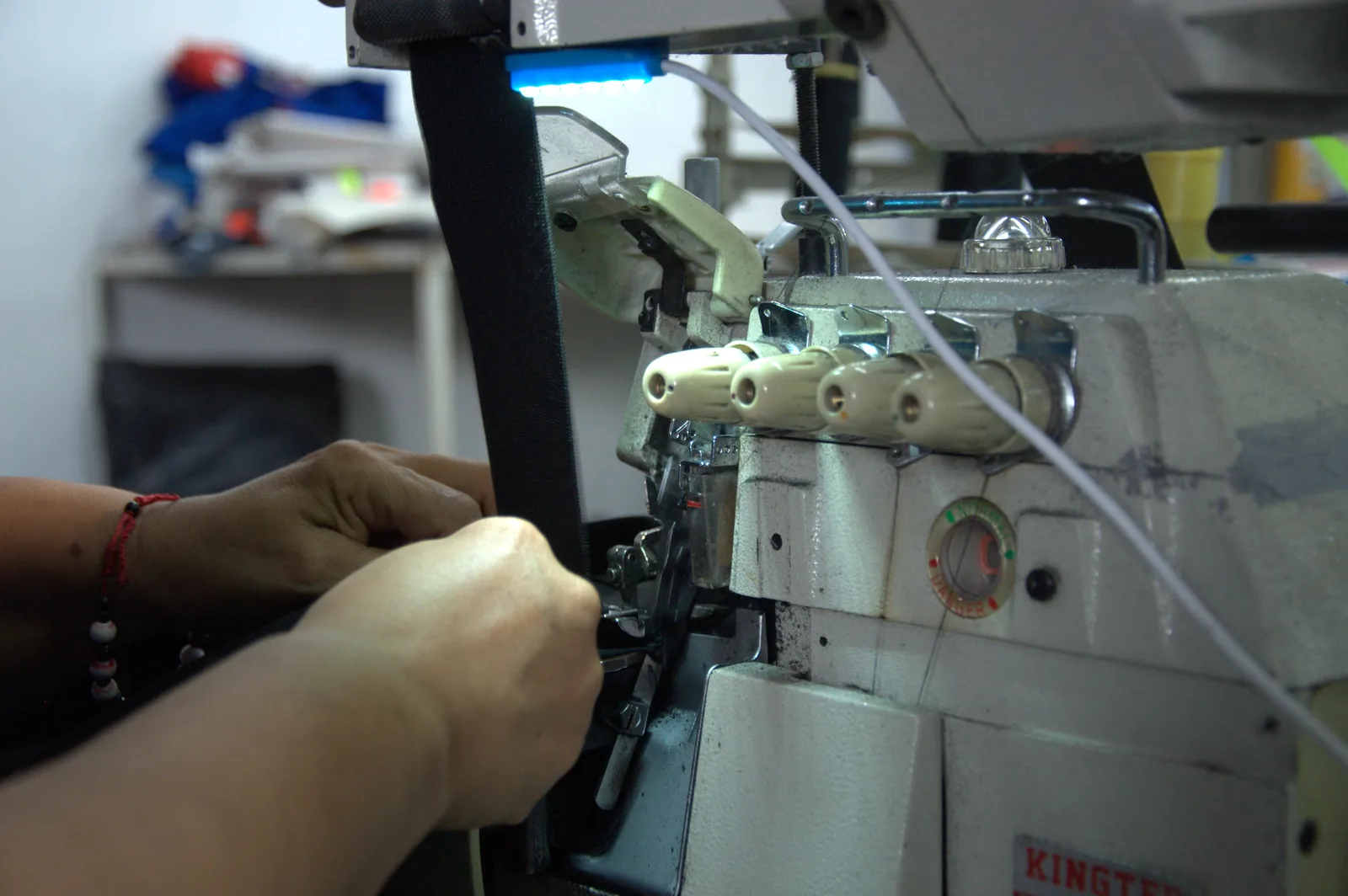
Before the first garment comes off the line there is a block of work that costs the same regardless of order size. Someone drafts the pattern, builds the marker (the cutting layout that arranges the pieces across the fabric), calibrates the machines, prepares the screen or the mold for the decoration and buys the raw material. All of that is fixed cost. The only way to make it weigh little per garment is to divide it across many garments.
The numbers say it without hedging. The same style can cost around US$14 per piece in a run of 100 units and fall to US$7.50 at 1,000, roughly 46% less per garment, according to Work Shelter. Screen printing setup, at roughly US$80 per color, follows the same logic: spread across 100 pieces it adds US$2.40 to each one, and across 1,000 it drops to US$0.24. That is why micro-factories willing to produce 20 to 50 units charge two to three times more per piece than a run of 500.
The fabric is what sets your real minimum
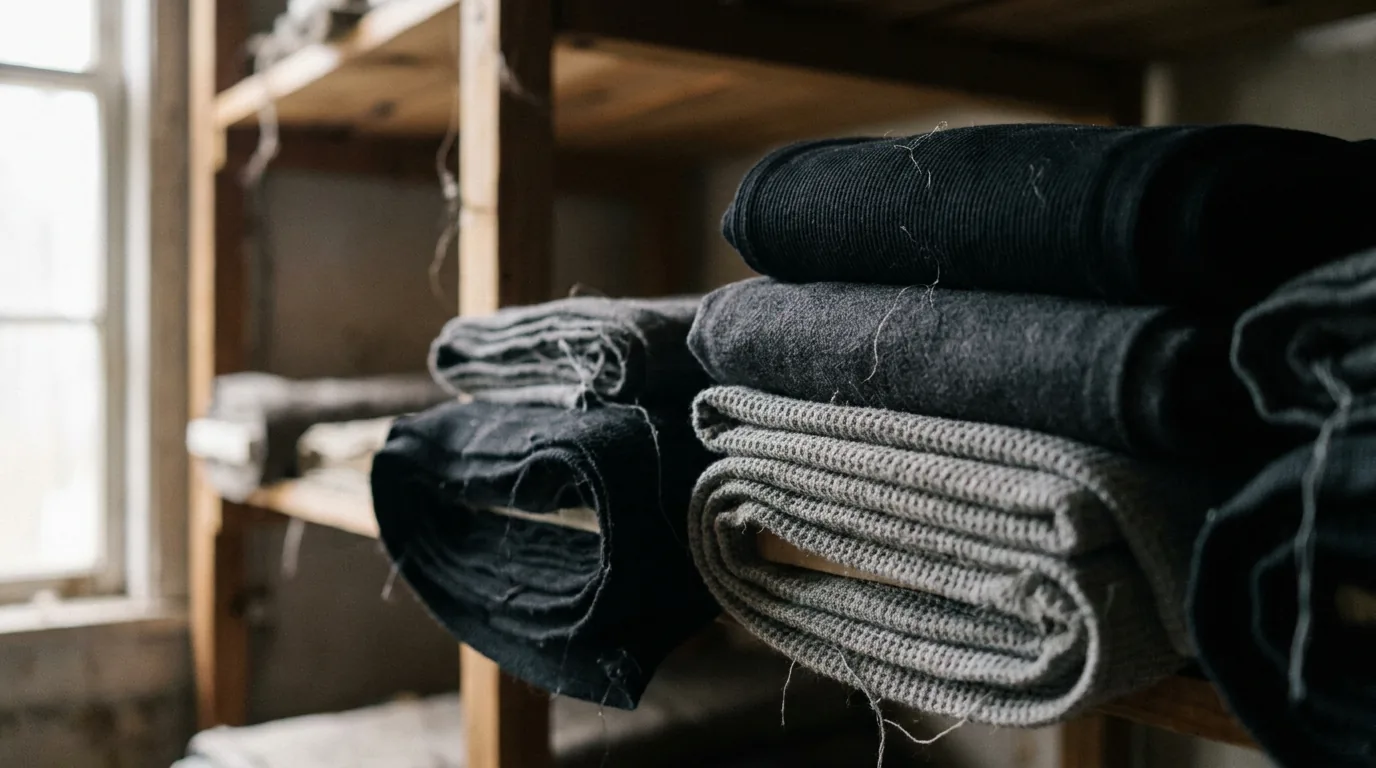
It is easy to assume the minimum comes from sewing. The bottleneck usually sits earlier, in the cloth. Dye houses do not dye less than roughly 100 to 200 kilos per dye lot, because every dye bath means mounting and cleaning the machine whatever the volume.
That creates material minimums many brands see too late. Stock fabric, already knitted and sitting in a warehouse, can be bought from around 50 to 100 meters. A color made to your specification asks for 200 to 500 meters. A special construction can demand 500 to 2,000. Buying below the dye-lot minimum raises the cost of each garment by somewhere between 15% and 35%, because that dyeing setup gets spread across fewer meters, according to Goodspeed Studio. Choosing the fabric moves your minimum more than any other single decision, which is why it pays to read the fabric guide before committing to an order.
How to calculate your MOQ, step by step
The minimum that suits you is not the lowest one available, it is the one that leaves profit without drowning you in inventory. The standard way to estimate it starts from break-even:
MOQ = (fixed costs + variable costs) ÷ profit per unit
A published example brings it down to earth: with US$1,000 of fixed costs, US$500 of variable costs and US$10 of profit per unit, the break-even minimum is (1,000 + 500) ÷ 10 = 150 units, according to Inbound Logistics. Below that number the project loses money on the setup. Above it you start gaining efficiency, and also inventory risk, which we come back to further down.
The other half of the calculation is understanding how the cost per garment falls as volume rises. It does not fall smoothly. It drops in steps, with the big ones coming when you move from a short run into the hundreds, and again when you reach the thousand.
| Units per style | Approximate cost per piece | What happens to setup |
|---|---|---|
| 100 | US$14 | Setup and fabric weigh heavily on every garment |
| 500 | Middle ground | Fixed cost is already spread much better |
| 1,000 | US$7.50 | Cost per piece close to its most competitive level, about 46% below the 100-unit figure |
Read the table as a shape rather than as a price list. Your actual numbers depend on the garment, the fabric and the decoration, and the only way to know them is to develop and measure the real sample.
What each type of manufacturer asks for
Not every factory starts from the same floor. The production model sets the range.
| Type of manufacturer | Typical MOQ per style |
|---|---|
| CMT workshop, cut and sew only | 50 to 100 units |
| Full package, development plus fabric, production and quality | From 36 at GAT, 100 to 300 recommended |
| Blanks | Low, but limited to what already exists |
| Scale factory, high volume, Asia | 300 to 500 or more |
The industry labels anything below 500 units per style as low MOQ, and anything above 5,000 as high volume, according to Wearview. A CMT workshop cuts and sews what you hand over, so its minimum depends on your fabric. A full package manufacturer also solves the development and the sourcing, so its minimum absorbs the dye lot of the material as well. The difference between contracting only the sewing and contracting the whole process is broken down in clothing factory vs full package service.
What each type of garment asks for
With the same manufacturer, the minimum also depends on how complex the garment is. Every extra panel, lining, zipper or trim adds setup work that needs volume to justify itself.
| Garment | Typical MOQ per style |
|---|---|
| T-shirt | 50 to 200 |
| Hoodie or sweatshirt | 100 to 300 |
| Activewear | 100 to 300 |
| Structured woven pieces | 200 to 500 |
Simple garments start around 100 units, and the more panels, linings and trims involved, the higher the floor climbs.
The low-MOQ trap: it multiplies by every color
The number that wrecks the most budgets is this one. When a factory advertises "minimum 50 units", that figure is almost never the total of your order. The minimum is counted per color of the design.
Do the arithmetic. The same tee in three colors is already three minimums to cover. If the floor per color is 50, your order does not come in below 150, which you then split across the sizes. The "low minimum of 50" became 150 without you changing a single line of the design. Multiply that by two or three styles and you can see why committed capital grows so fast.
In practice, count your order per color before you get excited about a low advertised minimum, and open with fewer colors so the total volume stays where your cash flow can carry it.
How to lower your minimum without burning capital
If the volume looks heavy, there are legitimate levers to bring the floor down without arguing with the factory:
- Reduce the colors. Fewer colors means fewer dye lots to cover, and it is the lever with the biggest effect.
- Use warehouse fabric instead of a custom color, and you skip the high dye-house minimum entirely.
- Group styles that share the same fabric so they reach the dye-lot minimum together.
- Negotiate staged payments or a larger deposit in exchange for a smaller lot.
- Fund the production with pre-orders, selling first and producing against real demand.
We work to flexible minimums, from 36 units per style and color up to the volume per style that best fits what you need. Reordering a product that is already developed usually takes 30 to 45 business days, so a style that is selling can be replenished rather than over-ordered up front.
The lowest MOQ is not always the best business
Bringing the minimum down carries a cost that never shows on the quote. Producing too little raises the price per garment, and producing too much leaves cash asleep in a warehouse. Holding that inventory costs between 20% and 30% of its value per year in storage, tied-up capital and obsolescence, according to Inbound Logistics. An MOQ that is too high is as risky as one that is too low.
The risk has a measurable size. The world produces somewhere between 80 and 150 billion garments a year, and between 8 and 60 billion are never sold, with the Ellen MacArthur Foundation putting the annual value of discarded unsold inventory at around US$500 billion, as reported by The Interline. Producing close to demand with a tight minimum is the most direct route away from that overstock.
Regulation is pushing the same way, and if you sell into Europe it now has a date on it. From 19 July 2026 the EU's Ecodesign for Sustainable Products Regulation prohibits large companies from destroying unsold clothing, accessories and footwear, with medium-sized companies covered from 2030 and small firms exempt. Companies also have to document and publish annually what they discard, and the Commission estimates that 4% to 9% of unsold textiles in Europe are destroyed each year before ever being worn, according to the European Commission. Sizing runs to real demand stops being only a cash-flow decision.
Why a manufacturer in your time zone lowers your inventory risk
Buying close changes the arithmetic. Ordering 1,000 units from a factory in Asia to bring the piece cost down looks good until you add the long lead time, the freight, the capital tied up for months and the risk of holding whatever did not sell. A manufacturer with a flexible minimum and a shorter delivery window lets you produce in tighter batches, replenish quickly and adjust to what is actually rotating.
Sourcing teams have been moving in that direction for a while. In the 2025 Fashion Industry Benchmarking Study, which surveys executives at leading US fashion companies, more than 80% of respondents now source from ten or more countries and around 60% planned to add still more in 2026, while 80% expected to keep reducing their sourcing from China, according to the United States Fashion Industry Association. Spreading production across more origins only works if some of those origins accept runs that are not container-sized.
Colombia has the industrial base for that role. Colombian fashion exports reached US$836.7 million between January and November 2025, up 2% year on year, with the United States as the leading destination, according to Analdex. GAT has spent more than 20 years manufacturing for recognized brands inside that industry, exporting actively to Central America, the Caribbean and the United States, so producing close and selling far is part of the model. The full comparison against Asian sourcing sits in Asia vs nearshore manufacturing.
Minimums at GAT: the style as the unit
At GAT the minimum is counted per style, meaning per design. The official floor is 36 units per style and color: each color of the same design carries its own minimum of 36, and those 36 are split freely across the sizes of that style. Between 100 and 300 is the range we recommend for the development to pay off in efficiency and cost, and we also produce high volumes for programs that need them. Real efficiency gains appear above the 300 to 500 mark.
The minimum also shifts with how you decorate the garment, because every technique carries its own setup.
| Decoration technique | Minimum per style, as a guide |
|---|---|
| DTF, standard or high density | No process minimum, the garment MOQ of 36 applies |
| Sublimation and digital printing | No process minimum |
| Screen printing | Around 100, can be split across colors |
| Embroidery | Around 100 |
So a tee reaches the 36-unit floor only when it is decorated with DTF. With screen printing or embroidery the minimum rises to about 100, because those techniques carry requirements the smaller quantities cannot absorb. Every order passes through an approved physical sample before production and a four-point quality audit, so what you sign off with your hands is what you receive. These minimums by technique are a consultative guide, and the exact number gets confirmed during development.
Capacity above the minimum
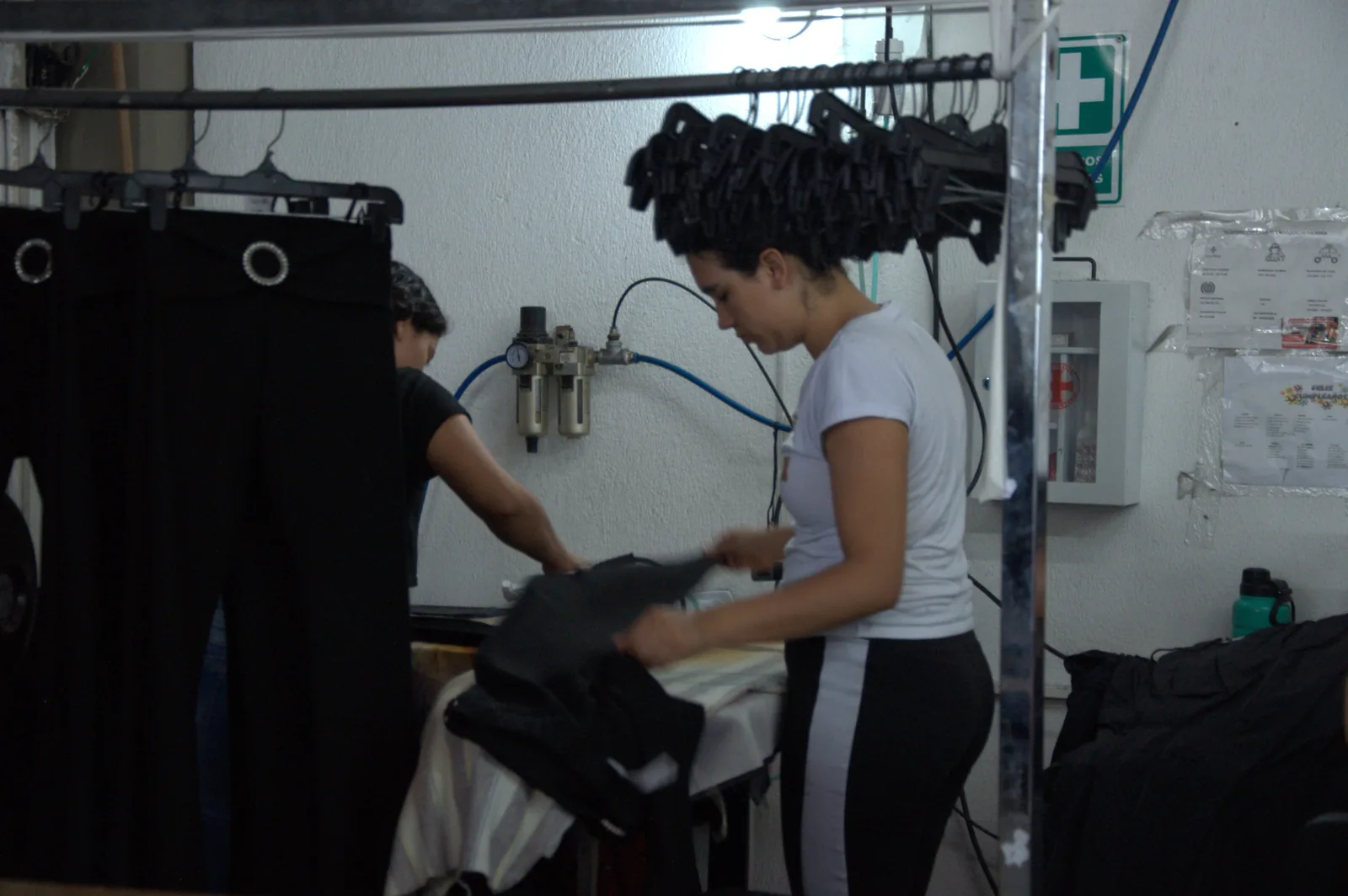
A low floor is not the same as small capacity. Our monthly production capacity runs in the range of 25,000 to 30,000 garments, and our development team takes on more than 120 new styles every month. We have delivered 5,000 garments in under 28 days when a launch demanded it. The point of the flexible minimum is that the same ally covers the pilot run and the volume program, so you are not rebuilding a supply chain every time the order size changes.
Frequently asked questions about clothing MOQ
What is the minimum order quantity to start a clothing brand?
It depends on the manufacturer and the garment. A sewing-only workshop starts around 50 to 100 units per style, a scale factory asks for 300 to 500 or more, and a full package manufacturer like GAT sets the floor at 36 units per style and color, with 100 to 300 recommended for better efficiency and cost.
Is MOQ negotiable?
Partly. The sewing side has some give, but the fabric minimum, meaning the dye house's dye lot, is far more rigid. You lower your real minimum by reducing colors, using warehouse fabric or grouping styles that share the same cloth, rather than by asking the factory to break its floor.
Why does the factory require a minimum at all?
Because the setup, meaning the pattern, the marker, the machine changeover and the fabric dye bath, costs the same regardless of order size. Below a certain number that fixed cost makes each garment so expensive that the project stops working for either side.
Is it cheaper per garment if I order very little?
The opposite. Fewer units means a higher cost per garment, because the setup is divided across fewer pieces. A run of 20 to 50 units can cost two to three times more per piece than a run of 500.
Can GAT produce fewer than 36 units?
No. Below 36 per style and color the setup cost cannot be spread far enough and the project stops being viable. If you genuinely need only a handful of generic pieces, a wholesaler is a better fit than a custom manufacturer, and we will tell you so.
Do you produce large volumes as well?
Yes. We produce from 36 units up to the volume per style that best fits what you need, with monthly capacity in the range of 25,000 to 30,000 garments. The recommended range of 100 to 300 is about where a project runs best on efficiency and cost, not a ceiling.
The one number left to close your calculation is a real cost per garment, measured on your own design. Get a free production estimate: with your design, your volume and your decoration technique, our quoting tool returns a figure in minutes. And if any term in this guide is still fuzzy, the apparel manufacturing glossary defines them one by one.