
US brands manufacture in Latin America for four reasons: shipping measured in days, a shared working day, minimum orders a fraction of Asian ones, and a factory you can fly to before lunch. What the region does not offer is the lowest unit price in the world, and that trade is the whole decision.
We are a Colombian manufacturer, so the bias here is obvious. What we can do is make the argument precisely enough that you can tell whether it applies to you, including the cases where it does not.
The four reasons, in order of how much they matter
1. Minimums you can actually sell
This is first because it decides whether a brand can use the region at all, and it is the one most often left out of the comparison. Plants built for offshore export volume have minimums to match. Regional plants organised around shorter runs open far lower. Ours starts at 36 pieces of a style in one colour.
For a brand doing 200 units of a style, the difference between a supplier who will take the order and one who will not is not a percentage on the unit price. It is the whole business.
2. Time in transit
Sea freight from Asia to a US port runs weeks, plus inland movement. From Colombia or Mexico it is days by sea, hours by air. That compresses the gap between deciding and selling, and it is what makes reordering within a season possible instead of committing to a forecast a year out.
3. The working day and the language of the conversation
Colombia runs on the same clock as New York, and is an hour or two from the West Coast depending on the season. A question sent in the morning is answered in the morning. Against a twelve-hour offset, every exchange costs a day, and a garment development is dozens of exchanges.
Cultural proximity is real too, and it shows up in something specific: the region's designers and technicians consume the same media as the US market, so a fit reference or a styling note lands without translation.
4. You can go
A flight of a few hours makes a factory visit an ordinary event rather than an expedition. Standing in a plant tells you in ten minutes what six months of emails will not, and being able to do it more than once is what turns a supplier into a working relationship.
The shift is measurable, not anecdotal
Manufacturers have been moving capacity from Asia towards Mexico and Colombia for several years. Forbes reported US manufacturers investing around US$11 billion in relocating plants from China to Mexico. Whatever the exact figure today, the direction has held long enough that the regional supplier base has grown to meet it, which is what makes the option real rather than theoretical.
Where the argument breaks
Three situations where Latin America is the wrong call, and it is worth being direct about them.
You compete on price at volume. If your product is a basic sold on the lowest possible cost, at quantities in the tens of thousands, the region will not beat Asia on unit price and the transit advantage is worth less to you than the cost gap.
Your fabric is not made here. Regional mills cover cotton knits, some synthetics and a decent trim base. Highly technical textiles frequently are not made in the region, so they get imported, and you have added a leg rather than removed one.
Your category is not served here. Every region has specialisations. Latin America is strong in knitwear, activewear, swimwear and casual, and thinner in structured outerwear and heavy technical gear. Ask about your specific garment, not about the region.
To run this against your own figures, including duty and rules of origin, use the Asia against nearshore comparison.
Which country, for what
| Country | Commonly strong in |
|---|---|
| Colombia | Swimwear, activewear, knit tops, lingerie, full package development |
| Mexico | Denim, uniforms, volume production, and the shortest land route into the US |
| Peru | Cotton knitwear, particularly pima, and vertically integrated mills |
| Guatemala and Central America | Knit basics at volume, with established US trade relationships |
| Brazil | A large domestic market, strong in denim and beachwear, less export-oriented |
Frequently asked questions about LATAM clothing manufacturers
Is Latin America cheaper than Asia for clothing manufacturing?
Not on unit price for comparable volumes. It is often cheaper on total landed cost for a US brand once freight, duties, transit time and unsold inventory are counted, and it is substantially cheaper on minimums.
Which Latin American country is best for clothing manufacturing?
It depends on the garment. Colombia for swimwear, activewear and knit tops. Mexico for denim and for the land border. Peru for cotton knitwear. Ask about your category rather than the region.
What are typical minimum orders in Latin America?
They vary widely by plant, and the range is broad enough that generalising is unhelpful. What is consistent is that regional plants oriented to shorter runs open well below the large offshore export factories, which is why smaller brands find the region workable.
How long does shipping take from Latin America to the US?
Days by sea from the northern coast of South America and from Mexico, and hours by air. Against weeks of sea freight from Asia, that gap is the practical argument for the region.
Can I visit a factory in Latin America easily?
Yes, and you should. Most capitals in the region are a direct flight of a few hours from major US cities, which makes a visit a day trip rather than a project.
Do Latin American manufacturers work with small brands?
Many are built for it. The regional supplier base includes a large number of plants organised around short runs, which is a different production setup from a volume export factory rather than a lesser one.
On shoring, and how far back production actually comes
On shoring in fashion means bringing production back to the country where the garment is sold. The variant that stops one step short moves the plant to a neighbouring region instead: close enough to shorten the shipping calendar, without paying home market labour rates. For a US brand, Colombia and Mexico sit in that second category, five to six flight hours from either coast.
The argument for either version is the calendar, not the unit price. Sea freight from Asia adds four to six weeks each way plus customs, and the order is decided before the season is read. Producing in the Americas moves that decision closer to the sales data, which is worth more than the cents per unit it costs.
How we work
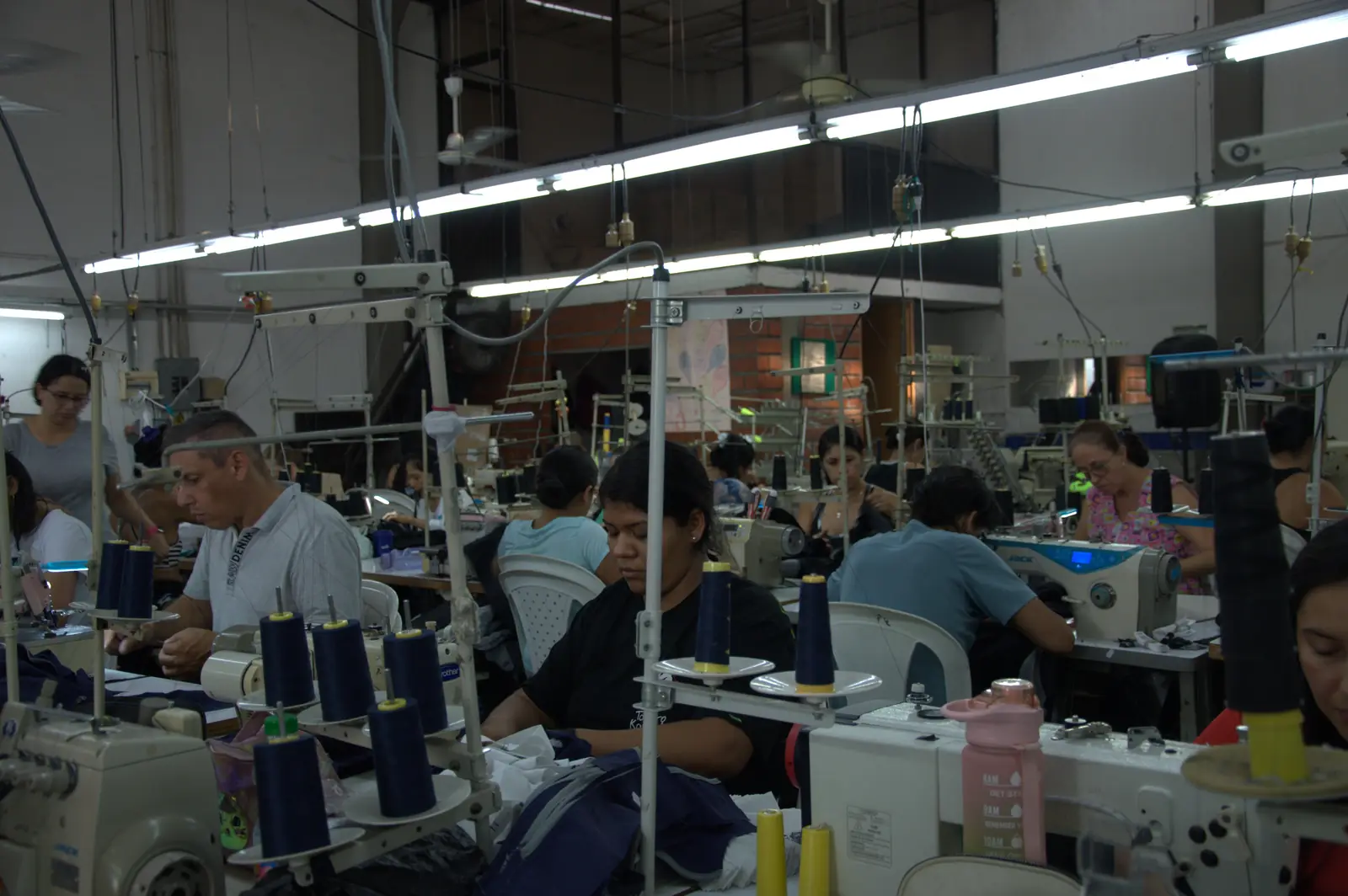
GAT Fashion Lab is one of the Colombian options this page describes. More than twenty years producing in Cali, a team of over 130 people, and full package service that carries a garment from your reference photograph to inspected stock. Development runs two to eight weeks, production 30 to 45 business days from sample approval. Prices are EXW at our plant, and DDP into the US can be arranged when it is settled before production. Our lane is garments cut and sewn from woven and jersey fabric, sports jerseys and team kit included. What sits outside it is anything needing flatseam construction, so leggings and compression wear, plus knitwear knitted to shape, denim, swimwear, shapewear and lingerie. Colombia is known for several of those, and we say so rather than take an order we would produce badly.
The concept behind all of this is covered in what nearshoring means for clothing production, and the practical search is in how to find manufacturers in Latin America. For a number on your own garment, use our quoting tool. From Colombia to the world.