Nearshoring clothing production is making your garments in a country close to where you sell them. For a US label that usually means Mexico, Central America or Colombia. The first thing it buys is communication: the team developing your garments works your hours and answers in your language. The trade is a higher price per garment.
We are GAT Fashion Lab, and we write this from Colombia, where we develop and produce garments in Cali for labels in the United States and Latin America. Most of what follows applies to the design-led label, the one carrying a few hundred units per style or fewer and selling on fit and finish, which nearshores for different reasons than a large retailer does.
What US fashion companies are nearshoring
Mainly basics, and a growing share of companies buy them in Central America. In the 2026 Fashion Industry Benchmarking Study, which surveyed sourcing executives at 30 leading US fashion companies between April and June, 76% sourced apparel from CAFTA-DR countries, up from 64% a year earlier. Over the next two to three years they plan to keep that sourcing narrow, led by T-shirts (67%), activewear and athleisure (33%) and bottoms (27%). China keeps shrinking in the mix: only 12% of respondents sourced more than 30% of their apparel there. The figures are in the study published by the United States Fashion Industry Association, summarized by its co-author Sheng Lu at the University of Delaware.
The same study adds a caution. The Western Hemisphere's share of US apparel imports has stayed largely flat for a decade, despite a tariff advantage, so interest in producing close is running ahead of the orders actually placed there. Most respondents named duty-free access among the top reasons for the volume they do send to the region, and use of the US-Colombia trade agreement also grew. A design-led label has a different reason to produce close, and it shows up in the sampling room. If duty and rules of origin are what you are working through, our comparison of Asia against nearshore production covers them, including why Colombia sits outside CAFTA-DR under its own agreement.
What nearshoring fixes for a design-led label
The conversation runs inside your working day
A garment is dozens of small decisions about fit, trims and finish, and each one travels as a message. Colombia keeps New York's clock for part of the year and runs an hour behind it for the rest, and the West Coast sits two or three hours behind Colombia. A question about a collar sent at ten in the morning can be answered the same morning, in English if that is how you write to us.
Sample corrections happen in conversation
Fit is rarely right on the first sample, so what matters is how quickly each correction gets resolved. When the people developing the garment share your hours, a fit comment can become a call the same afternoon instead of an overnight email chain. At GAT a garment usually spends 2 to 8 weeks in development, depending on how complex it is. Nothing goes into production until you have approved a physical sample, and the run is checked against that sample.
Runs sized for a collection
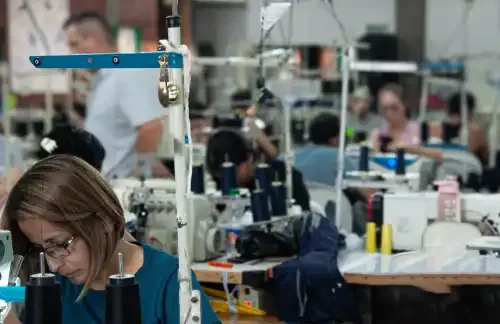
Large offshore programs are organized around volume per style. A design-led range needs the reverse, more styles with fewer pieces of each. We recommend 100 units per style, a number that lets a label carry a real range, and we produce thousands per style when you need more. From the moment you approve the sample, a run usually needs 30 to 45 business days, and each project keeps its own calendar. What affects that calendar most is whether the fabric and trims are in stock or have to be brought in. When a launch has needed it, we have delivered 5,000 garments in under 28 days.
You can visit us in Cali
Cali is around four hours from Miami by air. You can visit us at our offices in Cali to meet the team and see finished product. To set a date, write to us through our quoting tool, which is free and returns an estimate within minutes, and an advisor arranges the visit with you.
What nearshoring does not fix
The price per garment
Labor in the Americas costs more than in the lowest-cost Asian producers. For a basic sold on price, at tens of thousands of units and with a firm forecast, that gap decides the order, and Asia will usually take it.
Fabric that only exists offshore
Moving the sewing closer does not move the mill. If your garment depends on a technical textile produced only in Asia, that material crosses the ocean anyway and the time you gained goes into that leg of the trip. We work with Colombian mills and with imported fabric, and where yours comes from is settled during development.
Production time itself
Nearshoring shortens the distance and the conversation, while the run keeps its usual 30 to 45 business days. A reorder is a new production cycle of the same length, so a season built on fast replenishment is a plan the calendar will not support.
Garments outside the plant's lane
Every plant specializes, and asking about your exact garment tells you more than asking about the country. We make tops in knits and wovens, crewnecks and bodysuits included, plus pants, skirts, dresses and sports jerseys. We don't make denim, swimwear, knit sweaters, blazers or structured tailoring, lingerie and underwear, or shapewear and compression garments. Colombia has plants built for several of those. If you are not sure where your garment falls, send it through the quoting tool and an advisor will confirm.
How to tell whether nearshoring fits your label
- Count styles against units. Many styles at 100 to 300 units each make the case for producing close. Three styles at twenty thousand units each rarely do.
- Ask how much fit decides the sale. The more sample rounds a garment needs, the more a shared working day is worth.
- Trace the fabric. A regional mill strengthens the case, and a textile made only in Asia weakens it.
- Decide where delivery ends. We quote EXW by default, with values at our facilities in Colombia, and deliver DDP into the United States when it is agreed before production. Duties depend on the type of garment and can change, so any import estimate is a reference rather than a fixed number.
Frequently asked questions about nearshoring clothing production
What is nearshoring in the fashion industry?
It is producing garments in a country near the market where they will be sold, chosen for proximity more than for the lowest cost per piece. For a US label, nearshore clothing manufacturing usually means Mexico, the CAFTA-DR countries of Central America and the Caribbean, or Colombia.
What are the benefits of nearshoring fashion production?
For a design-led label, the main benefit is communication with the team developing the garments, in your hours and your language. That makes each sample round faster to resolve, lets runs be sized for a collection instead of a volume program, and puts the plant within a short flight. The price per garment is higher, and production time itself does not shrink.
Is nearshoring cheaper than manufacturing in Asia?
Per garment, rarely. For a basic sold at high volume, Asia usually wins on cost. The full comparison, with freight and duty included, is in Asia against nearshore production.
Why do large US fashion companies nearshore?
Duty treatment leads the list for volume programs. In the 2026 USFIA benchmarking study, over 65% of respondents named duty-free access among the most important reasons to source from CAFTA-DR countries and Mexico, and what they plan to buy there is mostly basics. A design-led label nearshores for communication and sampling instead. Which country suits your garment is covered in the case for Latin America, and how to reach a plant there in sourcing a manufacturer in Latin America.
How long does nearshored clothing production take?
It depends on the plant and the garment. At GAT, developing a garment usually takes between 2 and 8 weeks, and a production run between 30 and 45 business days once your sample is signed off. Shipping time to the United States varies with the ports and the carrier, so ask your forwarder for the actual rotation before you plan around it.
What is the difference between nearshoring and offshoring?
Offshoring places production far away, chosen mainly for cost, which for US brands has historically meant Asia. Nearshoring places it in a nearby country, chosen for proximity. Bringing production back into your own country is onshoring, which the case for Latin America compares with both.
How we work
In Colombia, at our facilities in Cali, GAT Fashion Lab develops and produces clothing for brands at home and abroad. We have more than 20 years in the business, with our own team working alongside specialized allies, through full package production, from a reference image to inspected, finished garments, and cut and sew manufacturing when you arrive with the design and the tech pack. US labels can pay in US dollars to GAT International LLC, our US company, as set out on our international page. Two US labels that have produced with us for this proximity are Daniel González, an independent designer who sends us the raw material guidelines, and Uncommon Runner, a sports brand. To price your garment, upload a reference image and your quantities to the quoting tool, and an advisor will follow up. From Colombia to the world.