
You need three things before a factory can give you a real number: what the garment is, how many you want, and what it has to feel like in the hand. Everything else in this guide exists to get you to that point without losing a season.
We manufacture for other people's brands, so this is written from the other side of the table. Most guides about starting a brand are written by people who have never had to cut the fabric. What stops most new brands is not the idea. It is the gap between a design on a screen and a spec a production line can follow.
What it actually costs to start
There is no single number, but the cost splits into four buckets and only one of them is the garment itself.
- Development. Patterns, samples and corrections. This is where you find out if the idea works in fabric. Budget for two or three sample rounds, not one. Development runs 2 to 8 weeks with us, and garments with several processes sit at the top of that range. We have delivered samples in under a week when a client had a date to hit, but that is a sprint, not the standard.
- Production. Fabric, trims, cutting, sewing, finishing. We buy the raw materials ourselves and deliver 30 to 45 business days after you approve the sample, so you are not chasing a mill while your launch date moves. Unit cost drops as quantity rises, which is the whole reason minimums exist.
- Landing the goods. Freight, duties, and the weeks your money sits in transit. We handle the import logistics, and when it is agreed up front we deliver DDP in the United States, the way we do for Daniel González and Uncommon Runner. Duties and import charges are set by each country and can change at the moment of import, so what we give you is an estimate, not a closed number.
- Selling them. Photography, site, ads. This one is yours, not ours: we do not sell your garments for you. Brands underestimate it and end up with stock they cannot move.
The market is big enough to be worth the trouble. Apparel in the United States is a US$373 billion market in 2026, and women's apparel alone accounts for US$196 billion of it.
Where to manufacture: at home, nearby or in Asia
Most US brands do not manufacture at home, and the numbers explain why. Apparel manufacturing in the US employs about 84,000 people in the entire country. That is a small base for a US$373 billion market, so domestic capacity is scarce and priced accordingly.
That leaves two real options, and they trade off differently.
| Factor | Asia | Nearshore (Latin America) |
|---|---|---|
| Unit cost at volume | Lowest | Higher |
| Minimum per style | Often 500 to 1,000+ | From a few dozen |
| Sample round trip | Weeks | Days |
| Time zone | 10 to 13 hours apart | Same business day |
| Reorders | A season away | 30 to 45 business days |
Read that table honestly: Asia wins on price per unit at high volume. Producing closer wins on everything that costs you time, and time is what kills a first collection. If you are still learning what sells, correcting a sample this week instead of next month is worth more than a few cents per garment.
What a factory needs before it can quote you
This is the part that surprises most founders. To price a garment we need to know what it is made of and how it is built.
- A reference or a tech pack. A tech pack lists the fabric, the trims, the measurement points and the construction. If you do not have one, a photo of a garment you like is enough to start with us: upload it to our quoting tool and we work from there.
- Quantities per style and color. Cost per unit moves with volume, so a quote without a quantity is a guess.
- Your target price. Telling a factory what the garment has to cost is not a weakness. It lets us propose the fabric that fits your margin instead of quoting something you cannot sell.
- Your date. Working backwards from a launch is the only way to know whether a timeline is real.
Arriving without a tech pack is normal for a first collection. We develop 120+ new styles every month and many of them start as a photo and a conversation. If that is where you are, you can start from zero with us: send the reference images through our quoting tool, we come back with an estimate, and the first samples come out of that. Our team builds the tech pack during development and hands it to you with the samples, so the document exists before production starts.
How long it takes
Two clocks run at different speeds, and confusing them is the most common planning mistake.
Development runs 2 to 8 weeks and depends on how many corrections a style needs. Production runs 30 to 45 business days and starts only after you approve the sample. Those are the two execution windows to plan against. What moves them most is sourcing the fabric and the trims: it depends on where they are, whether they are available immediately, or whether they have to be made.
End to end, a full package order runs about 25 to 27 weeks from first contact to delivery once you count development, fabric sourcing and shipping. Every project is different, and we can meet tighter requirements when a project calls for it. We have delivered 5,000 garments in less than 28 days with everything approved and the fabric in house, which tells you what the line can do, not what a first order will take.
Plan your launch against the long number. If it comes in shorter, you gain margin. If you plan against the sprint, you miss your season.
Minimum order quantities, and why they exist
A minimum is not a sales tactic. Setting up a production line costs the same whether it runs 30 garments or 3,000: the marker, the fabric order, the machine setup and the first-piece approval all happen once. Below a certain number, that setup makes the unit cost absurd.
We produce from 36 units per style and color, and 100 to 300 is where a project runs best on efficiency and cost. We also produce thousands of units per style.
Where the entry number gets expensive is the reorder. If you make 36 units and they sell, the next 36 are another 30 to 45 business days away, and that is close to two months with nothing to sell while the demand you just proved cools off. An empty shelf costs more than the extra units would have. Decide your reorder plan before the first order ships, not after the first one sells out.
The mistakes we see most often
- No plan for when, how many and at what price. This is the big one. Established brands arrive knowing the date they need stock, the quantity and the target cost per garment. New brands almost never do, and everything downstream gets decided in a hurry because of it. Answer those three questions before you talk to a factory.
- Designing without choosing a fabric. The same silhouette behaves differently in every fabric. Picking the material late means redoing the pattern.
- Planning for one sample round. Almost nothing is right the first time. Two or three rounds is the normal path, not a failure.
- Ordering the full size range on style one. Sizes multiply your minimum. Start narrow, learn what sells, then extend.
- Choosing on price per unit alone. The cheapest quote often leaves out the fabric, the quality checks or the corrections, and those come back as cost later.
- Nobody accountable. When the fabric supplier, the pattern maker and the sewing shop are three separate vendors, every delay becomes somebody else's fault.
Launching at the luxury end changes the plan
A luxury clothing brand in the US runs the same steps in a different order. The fabric list comes first and it is short, because origin has to be provable. Construction adds operations most plants skip, so the sampling stage takes longer and costs more per round. And the run stays deliberately small, which means volume never pays down your development the way it does at other price points. If that is the brand you are building, the detail is in starting a luxury clothing brand.
Frequently asked questions
Do I need a tech pack to get a quote?
No. A reference garment or a clear photo is enough to start. The tech pack has to exist before production, and if you do not have one, our team builds it during development and hands it to you with the samples.
How much money do I need to start a clothing brand?
It depends on the garment, the fabric and the quantity, so any number quoted without those is guesswork. Plan development and production as two separate budgets and keep a third for selling. The common failure is spending everything on stock and nothing on getting it seen. Send us your reference and your quantity through our quoting tool and the estimate is free.
Can I start with a single style?
Yes. Many brands launch with one or two styles in a couple of colors, learn what sells and expand from there. From 36 units per style, that is a realistic first order, and 100 to 300 is where the numbers work better.
Is it cheaper to manufacture in the USA?
Rarely, and capacity is limited: apparel manufacturing employs about 84,000 people in the whole country. Most US brands produce abroad and choose between the lower unit cost of Asia and the speed of producing closer to home.
Who owns the patterns?
With us, the editable pattern is yours once development is paid in full. Ask any factory that question before you start, because the answer is not the same everywhere.
Where to go from here
If you are still choosing a production model, the difference between private label, white label and custom manufacturing decides how much of the garment is actually yours.
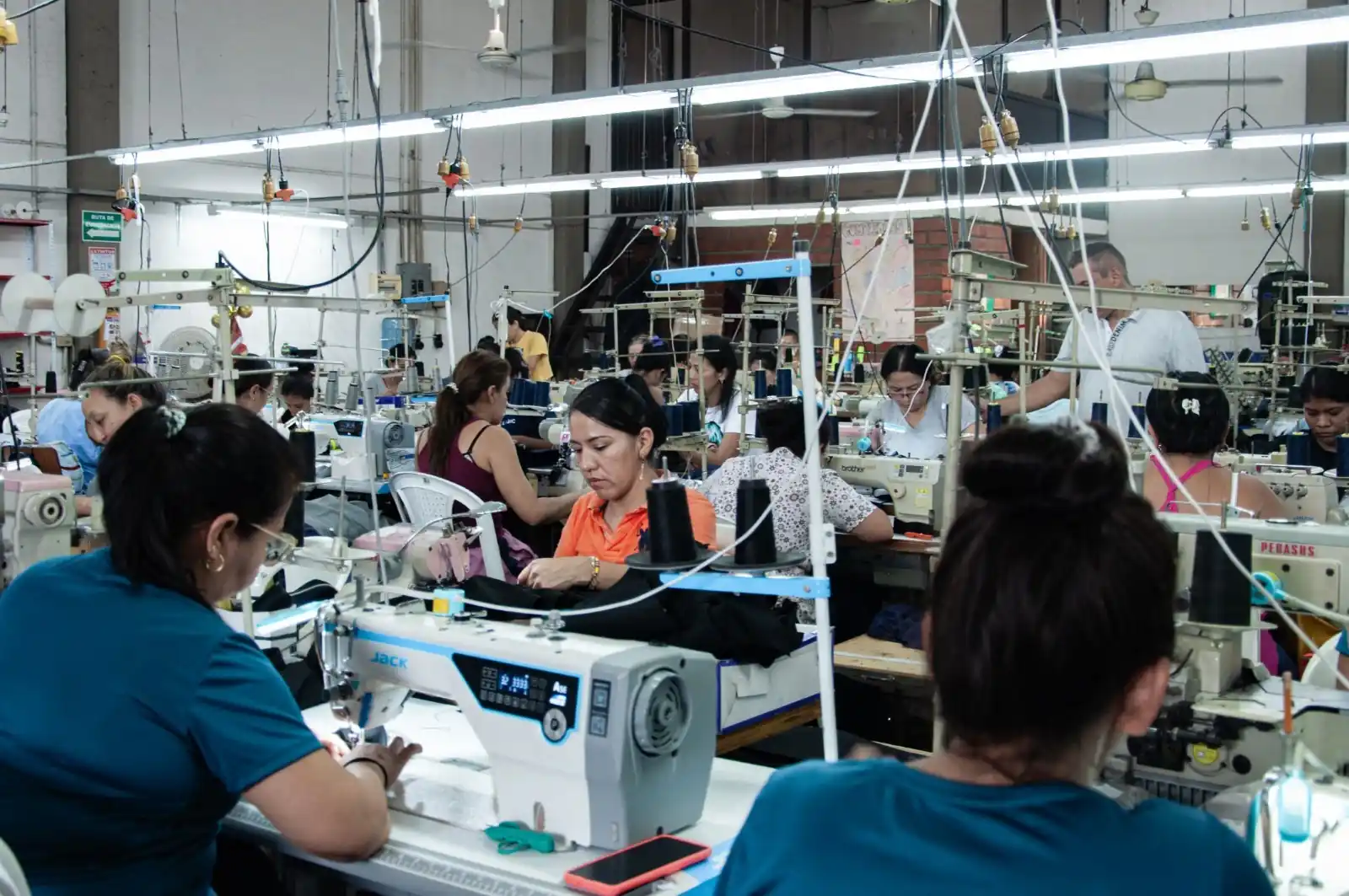
If you already know what you want to make, this is what working with us looks like. We are a clothing manufacturer in Cali, Colombia, in your time zone and a short flight away, with 130+ people and more than 20 years making garments for brands that sell in Latin America and the United States. You get one team accountable for the whole thing: development, the tech pack, the fabric, production and the shipment, including DDP delivery to the US when it is agreed up front. Send us a reference image and a quantity through our quoting tool. The estimate is free and it comes back in minutes.