
A textile maquila only cuts and sews what you hand over, so before you hire one you need patterns, graded sizes, fabric, trims and an approved sample already in your hands. Then check three things: machinery matched to your category, formal employment on the floor, and who pays when a batch comes back wrong.
Swimwear and activewear founders in the United States usually end up choosing between two setups: a cut and sew maquila that stitches what you supply, and full package manufacturing, where the factory buys the raw materials and hands you finished garments. What follows is how to tell which one your brand can actually run this season.
What a textile maquila covers, and where its responsibility ends
Maquila is the Latin American name for CMT: cut, make and trim. The shop receives your materials and your instructions, and returns sewn garments. Everything upstream of the sewing line stays with you. The term has several variants by country and by scope, and we unpacked them in a separate guide on what a maquila is.
| What you supply | What the maquila supplies |
|---|---|
| Graded patterns and the tech pack | Cutting, sewing and trimming labor |
| Fabric, elastics, drawcords, zippers and labels | Machines and operators for your stitch types |
| An approved physical sample to copy | In line checks against that sample |
| Freight of materials in and garments out | Packing and folding to your instructions |
That split is the reason a maquila quote reads lower than a full package quote. You are buying labor. The sourcing, the fabric yield risk and the coordination stay on your side of the table, and they are real work with a real cost.
Why swimwear and activewear are harder to place than a t shirt
Both categories live on stretch knits with elastane, and stretch punishes a shop that learned on wovens. A maquila can be excellent at shirting and still ruin a swim bottom. These are the questions that separate one from the other.
- The machine list, by style. Flatlock, coverstitch, bartack and elastic attachment are different machines, not settings. Ask which ones will run your specific style, instead of asking whether the shop works with knits.
- Elastic application. Leg openings, straps and waistbands are where swimwear fails first. Ask to see a finished piece from the same shop, wash it and stretch it before you commit a purchase order.
- Fabric behavior. Chlorine and oil resistance, four way stretch and recovery after washing are properties of the fabric you buy, not of the sewing. In a maquila arrangement that choice is yours alone.
- Grading on stretch. A swim bottom graded like a woven skirt will fit nobody. Confirm who is responsible for the graded size set, because most maquilas will simply cut what your pattern says.
- Linings, cups and reinforcement. They multiply the operations per garment and they are where the sewing minutes hide. A quote given before these are defined is a guess.
At GAT Fashion Lab we work the other way around: nothing reaches the production line until a physical sample is approved, and our minimum starts at 36 pieces per reference and color, so a category with this much technical risk can be tested small before it is scaled. Two of the US brands whose garments we produce sit in this territory, Uncommon Runner in sportswear and Daniel González in author driven design with low minimums. Ask what a repeat order looks like too. Coming back for the same reference means another 30 to 45 business days, so the floor works for a test and rarely for a launch.
Seven checks to run before you hire a textile maquila
- Ask for the machine list per style. A shop that answers with brand names and stitch types has the equipment. A shop that answers "we make everything" is quoting your job to somebody else.
- Settle who buys the fabric and who absorbs the yield loss. In a maquila you buy it, and if the marker consumes more than planned, the extra meters are yours. Put the expected consumption per garment in writing.
- Approve a physical sample before the line starts. Photos of a similar garment are not an approval. The sample is the contract, and it is what any in line check compares against.
- Match capacity to your calendar. Ask for units per month in your category, not in general, and ask what else is on the floor during your window. Inflated capacity is the most common misrepresentation in this industry.
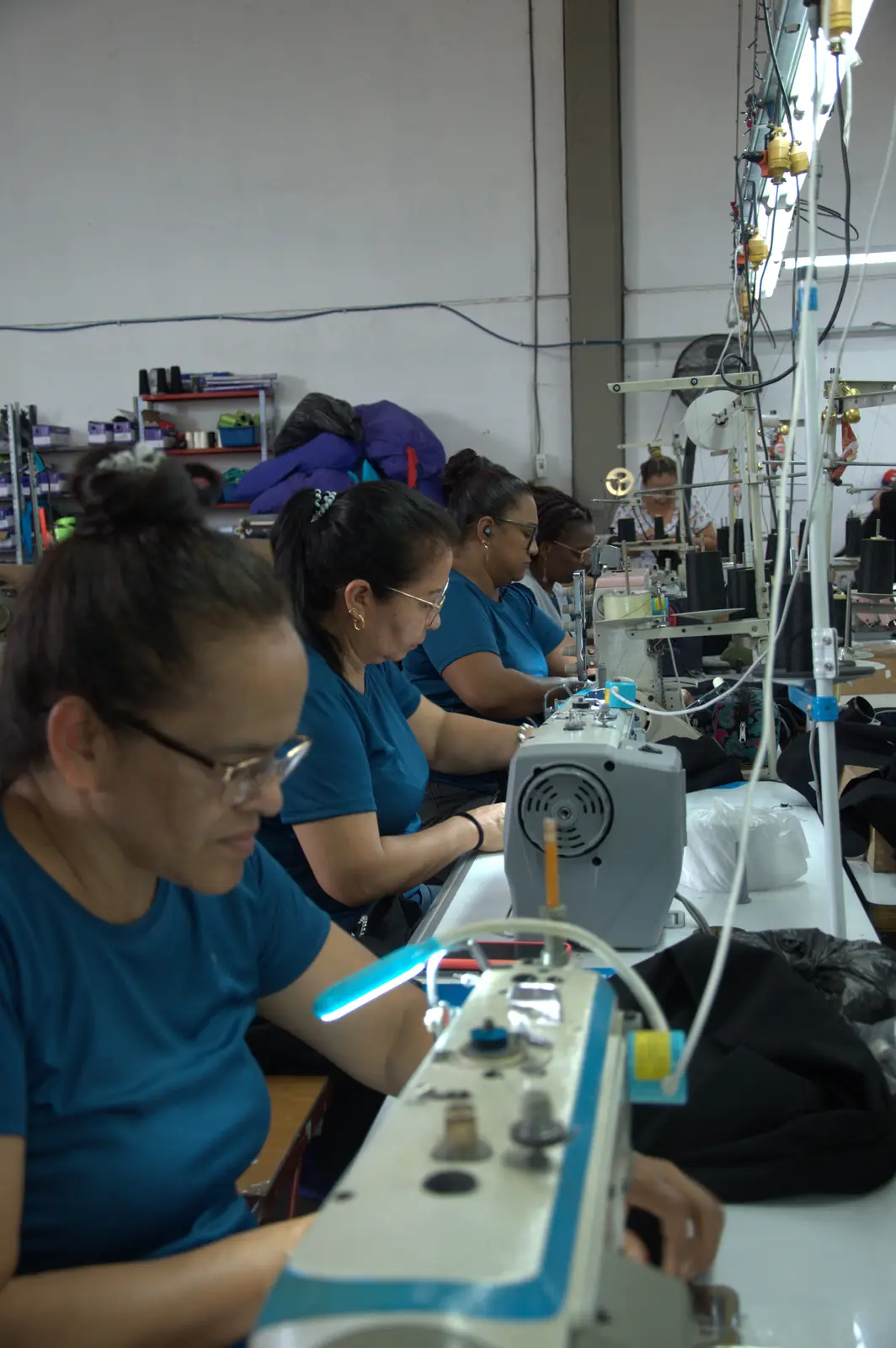
- Verify formal employment. Ask how many people are on payroll, ask about absenteeism, and ask which labor standards the plant is audited against, such as the WRAP principles. Informal shops miss delivery dates because their people can leave on any given Monday.
- Agree what happens to defective units before there are any. Rework, replacement, credit or nothing at all. Whichever it is, write it down, because a maquila that only sewed what you sent has a strong argument once the batch is late and wrong.
- Pin the commercial terms and who moves the goods. Colombian factories quote EXW by default, meaning values are set at our facilities, and DDP can be agreed when the client needs it. Duties and import charges are outside the factory's control, so any estimate on those is subject to change.
The costs a maquila quote does not include
Sewing labor is the visible line. Around it sit the ones a first time founder discovers late: sourcing and buying fabric in another country, the trims that arrive after the fabric does, the freight of materials into the plant, an inspector or a trip of your own to check the batch, the rework when it comes back off spec, and the meters that were cut and thrown away. Add them before you compare two quotes, because they are the difference between the two models and not a rounding error.
There is also the part nobody manufactures for you. Your product photography, your store and your paid media stay with you in either model. A factory that claims those is selling you a brochure.
How GAT works, and when a maquila is still the better fit
GAT Fashion Lab is a clothing factory in Cali, Colombia, with more than 20 years producing for brands and a team of over 130 collaborators, 75% of them women. Capacity runs around 25,000 to 30,000 units a month. We work full package: we develop the product, buy the raw materials, produce and control quality through eight internal stages. Development takes 2 to 8 weeks depending on the complexity of the garment, and production runs 30 to 45 business days after the sample is approved.
A maquila is still the better call when you already own the upstream. If you have a pattern room, a fabric supplier you trust, a graded size set that fits and enough volume per color that labor is the only line left to negotiate, CMT is the efficient answer and paying for full package would be paying twice. If any one of those is missing, the gap does not disappear, it just moves onto your calendar. That is the moment to look at product development or private label manufacturing instead.
Frequently asked questions about hiring a textile maquila
Does GAT Fashion Lab work as a textile maquila?
No. GAT Fashion Lab works full package, which means we develop the product, buy the fabric and trims, produce and run quality control before shipping. We do not take in pre cut pieces to sew. Brands that already have their own materials and patterns are better served by a dedicated CMT shop.
What do I need to have ready before hiring a textile maquila?
A graded pattern set, a tech pack with construction and measurements, the fabric and every trim delivered to the plant, and a physical sample the shop can copy. Without those four, a maquila will either stop the line or improvise, and improvisation on stretch fabric is how a batch is lost.
What minimum order should I expect for swimwear or activewear?
It varies widely by shop, and industrial maquilas set high minimums because they are built for volume. At GAT the minimum starts at 36 pieces per reference and color, though 100 to 300 is the range we recommend for a launch that needs to hold size curve and cost together.
How long does a first production run take?
Plan for two blocks of time. Development, which covers patterns, prototypes and the approved sample, takes 2 to 8 weeks depending on how technical the garment is. Production takes 30 to 45 business days counted from sample approval, not from the day you sent the design.
Who pays for defective units in a maquila arrangement?
Whoever wrote it into the agreement. If nothing was written, the practical answer is usually you, because the shop can argue it sewed exactly what your sample and your tech pack specified. Define the acceptable defect rate, the inspection method and the remedy before the first cut, and inspect during production rather than after.
Where to start based on where you are
- You have patterns, a fabric supplier and an approved sample. A maquila can work for you. Run the seven checks above, starting with the machine list and the defect clause.
- You have designs and reference images but no tech pack. Skip the maquila search for now. A reference photo is enough to start a conversation with us, and our team builds the tech pack during development.
- You are a US brand looking to produce closer to your market. Colombia is a short flight and a shared time zone away, and our quick guide to finding a clothing factory in Colombia covers how to vet one from abroad.
If your next step is a number rather than more research, send us the reference and the quantities through our quoting tool. It is free, you get an estimate in minutes, and an advisor follows up to review the technical side of your garment with you. From Colombia to the world.