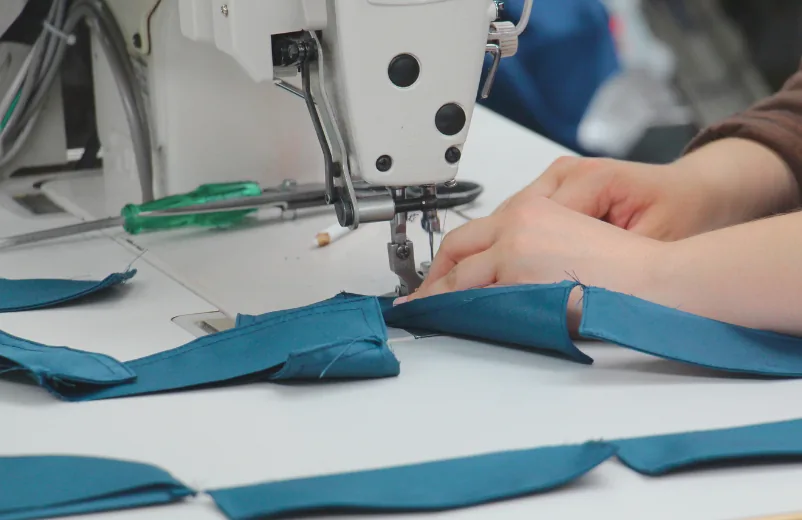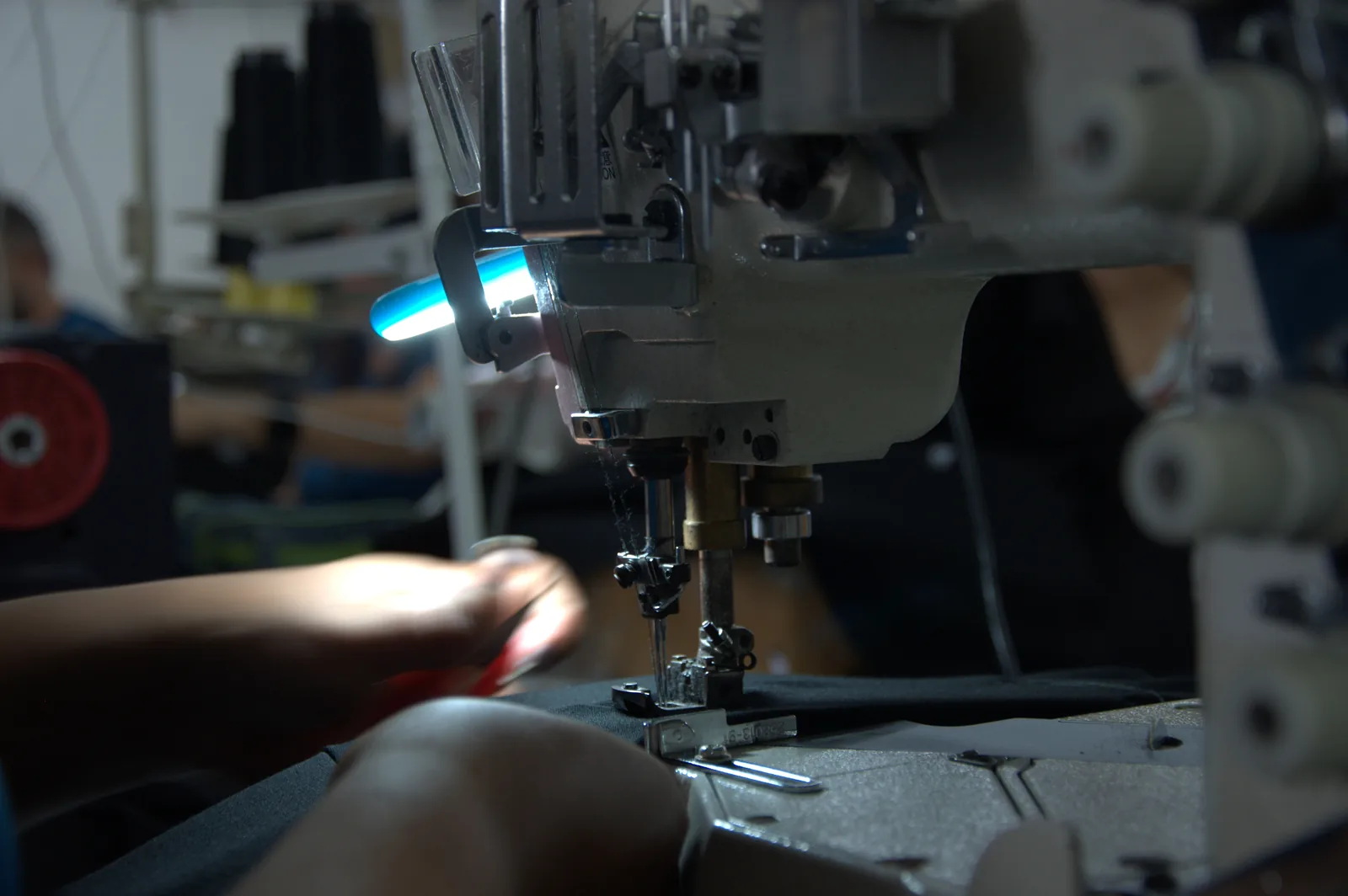

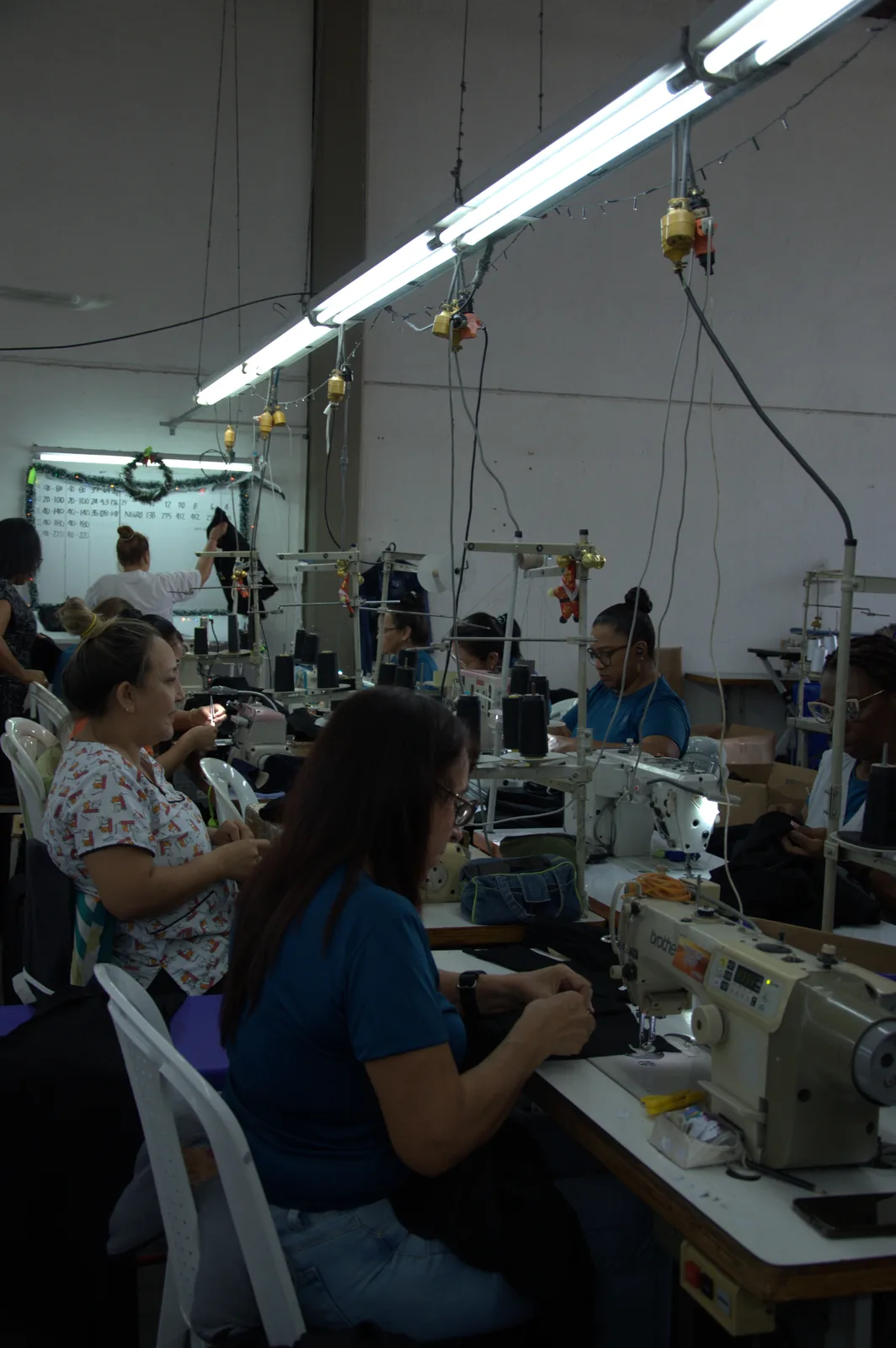
A garment factory is a facility that turns fabric into finished clothing at industrial volume: cutting, sewing, finishing and quality control organised as a production line. What separates one from another is scope, from a workshop that only sews to a plant that develops the garment and buys the materials itself.
The word covers all of them, which is why quotes from two places calling themselves the same thing can differ by a factor that makes no sense until you know what each one included.
What happens inside one
The sequence is the same in every plant that makes clothes, whatever its size.
- Fabric inspection. Rolls checked for weave faults, shading and shrinkage before anything is cut, because a fault found later costs the whole lay.
- Spreading and cutting. Fabric layered on a long table, the marker laid out to waste as little as possible, pieces cut by hand or by automated cutter.
- Bundling. Cut pieces grouped by size and colour and released to the line.
- Sewing. Each operator performs one operation repeatedly and passes the garment on. This division is what makes industrial output consistent rather than artisanal.
- Specialist processes. Printing, embroidery, washing, pleating. Usually done by dedicated units, often subcontracted.
- Finishing and quality. Thread trimming, pressing, measurement against the approved sample, defect reporting.
- Packing and dispatch. Sorted by style, size and colour, packed, documented, shipped.
Stages one and six are where factories differ most in practice. Everyone cuts and sews. Not everyone inspects fabric before cutting or checks the garment while the line is still running.
The four kinds you will be quoted by
Maquila, or CMT
Sewing labour, sometimes including cutting. You supply the pattern, the graded sizes, the fabric and every trim. The plant returns sewn garments. Cheapest per unit, and it assumes you have already solved development and sourcing yourself. Where a maquila's job ends.
Full package
One supplier from reference to finished stock, buying the materials along the way. Development, pattern, sourcing, production, quality and dispatch all sit with them. More per unit and far less work for you. What full package covers.
Private label
The factory already developed a garment and sells it to you with your labels applied. No development to pay for, no pattern to own. Fast, and the garment is shared with the factory's other buyers.
Dressmakers, tailors and ateliers
Individual garments made one at a time, to measure. The right answer for a single piece or a very small couture run, and not a production route, because the cost per garment never comes down.
How to tell which one you are talking to
Company names and website copy are unreliable here, and many suppliers describe themselves as whatever the enquiry seemed to want. Two questions settle it.
Who buys the fabric? If you do, it is a maquila or a specialist. If they do, it is full package, private label or vertical.
Who owns the pattern? If you do, it is a maquila or full package. If they do, it is private label.
Everything else, machine count, certifications, client list, is context. Those two answers are the specification of what you are buying. The full taxonomy of manufacturer types extends this to ten.
How to find one
Trade fairs, national export agencies and their supplier directories, fabric and trim suppliers, and referrals from brands already producing. Search engines are useful for building a long list and close to useless for shortlisting, because the factories with full order books have no reason to compete for search traffic.
Wherever the plant is, visit it before committing a production order, or send someone who can. It is the only check that cannot be faked.
By country, the specifics change a great deal. Finding a manufacturer in Colombia, in Mexico and in the UK each have their own routes and their own traps.
The vocabulary in this trade is dense and inconsistently used. Our glossary of garment manufacturing terms defines the ones that come up in a quote.
Frequently asked questions about garment factories
What is a garment factory?
A facility that produces clothing at scale by dividing the work into stations: fabric inspection, cutting, sewing, specialist processes, finishing, quality control and dispatch. The division of labour is what distinguishes it from a tailor's workshop.
What is the difference between a garment factory and a clothing manufacturer?
In everyday use, none. In trade use, factory tends to describe the physical plant and manufacturer the commercial counterpart, which can be the same company or can be an intermediary that subcontracts the actual sewing.
Where are most clothes manufactured?
Asia produces the majority of the world's apparel by volume, with China, Bangladesh, Vietnam and India as the largest producers. Latin America, Turkey and Portugal hold significant share for brands prioritising shorter lead times and smaller runs.
How many garments can a factory produce?
It depends entirely on the number of machines, the garment's complexity and how many operations it takes. A meaningful answer only exists per style, which is why capacity questions are best asked as "how long would my order take" rather than "how much can you make".
Do garment factories work with small brands?
Many do, and it is a matter of finding one whose minimums match your stage rather than convincing a large plant to shrink. Plants organised around short runs are a different setup, not a lower-quality one.
What is a fashion factory?
The same thing, phrased more loosely. It is used both for garment production facilities and, in marketing copy, for design studios that produce nothing. Ask what machines are in the building.
Where clothes are manufactured, and by whom
Most of the world's clothing is made in Asia, with China, Bangladesh, Vietnam and India holding the largest share by volume. The Americas take a smaller but growing slice: Colombia, Mexico, Peru and Guatemala supply North America on shorter calendars. Europe keeps Portugal, Turkey and Italy for shorter runs and heavier construction.
Fashion factories are not one kind of business
The word covers at least four operations that share nothing but a sewing floor. Mills make fabric. Cut and sew shops assemble what you send them. Full package plants develop the product and produce it. Finishing houses print, wash or embroider what somebody else sewed. Asking "do you have a factory" gets a yes from all four.
The garment industry in one paragraph
The clothing industry runs a chain that starts with fibre and ends on a hanger: fibre, yarn, fabric, cut, sew, finish, ship, sell. Each link is usually a separate company, and the brand sits outside all of them. Working out which link your supplier occupies explains most of what they can and cannot do for you.
How quality assurance works inside a clothing factory
QA in a clothing factory happens at four points, not one. Fabric inspection before anything is cut, in line checks while the operation runs, end of line inspection piece by piece, and a random audit on the packed order. A plant that only inspects at the end is finding problems at the moment they cost the most to fix.
How we work
GAT Fashion Lab is a full package plant in Cali, Colombia, and has been producing for more than twenty years for recognised regional brands and for independent labels shipping abroad. The seven stages above all happen with our own people, which is why a question about your order reaches someone who has seen it. Two things we do not make: denim, and tailored outerwear.
If you want to know what your garment would cost here, describe it in our quoting tool. It is free and the estimate arrives in minutes. From Colombia to the world.