
Generative AI has compressed the front of fashion design: moodboards, concept variations and print artwork now take hours instead of weeks. It has changed almost nothing after that point. A generated image is not a pattern, and turning one into a garment still requires the same pattern maker, sample and correction loop.
We receive AI-generated references from brands regularly, so the useful thing we can add is the handover: what arrives, what is usable, and what has to be rebuilt from scratch before anything can be cut.
Where it genuinely helps
- Concept exploration. Forty silhouette variations in an afternoon, against three in a week. The value is in discarding faster, not in the final image.
- Moodboards and direction. Building a visual language for a collection before committing to any of it.
- Print and surface design. The clearest win. Repeating patterns, colourways and placements are exactly the kind of output these tools produce well, and a print does not need to obey physics.
- Colourway variations. Seeing a design in twelve palettes without redrawing it.
- Presentation and pitching. Showing a buyer a convincing image of something that does not exist yet.
Where it stops
The gap between a generated image and a producible garment is larger than it looks, and it is where most AI-first projects lose the time they thought they had saved.
The image is not a specification. A render shows a garment from one angle in one state. A factory needs the pattern, the seam positions, the fabric weight, the trims, the measurement chart across the size run. None of that is in the picture.
Physics is optional in a render and mandatory in a garment. Generated designs routinely include a drape that the named fabric cannot produce, a seam that cannot close, or a construction that would need a machine nobody makes. Someone has to catch this, and that someone is a pattern maker.
Fit is invisible. An image cannot tell you whether the armhole works when the wearer raises an arm. That is what a sample is for, and no amount of image quality substitutes for it.
3D garment simulation is a different technology and does address some of this, because it works from the actual pattern rather than from pixels. What 3D clothes design replaces covers that boundary.
Creative homogenisation, which is a real risk and not a slogan
Generative tools are trained on what already exists, and they are tuned to produce what is statistically likely. Prompt several designers with similar words and the outputs converge, because they are drawing from the same distribution.
The practical consequence for a brand is competitive rather than aesthetic. If your design process is a prompt, your competitor can reach the same place with a similar prompt, and neither of you owns anything. Distinctiveness now lives in the parts the tools cannot reach: your fit, your fabric choices, your construction details, your point of view.
The designers getting the most out of this are using it to explore and then deliberately departing from what it produced. Using the output as a destination is where the sameness comes from.
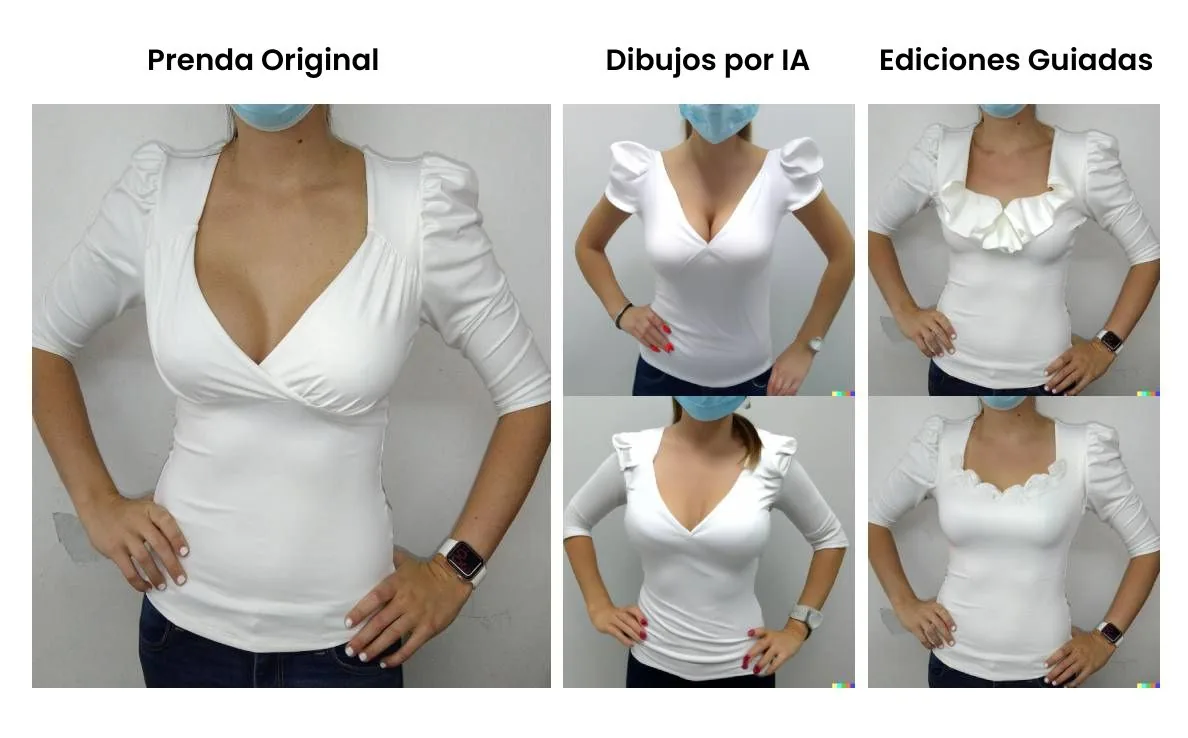
How to hand an AI-generated design to a factory
If you arrive with generated images, four things make the difference between a fast development and an expensive misunderstanding.
- Say which parts are intent and which are literal. Is that neckline the point, or is it whatever the model produced? A factory cannot tell, and will either copy an accident or discard something you cared about.
- Bring more than one angle. Front, back and any detail that matters. Most generated references show only a front.
- Name a fabric direction, or accept ours. The render implies a fabric that may not exist. Deciding this early prevents a sample in the wrong cloth.
- Bring a garment you already own that fits well. This single item resolves more fit questions than any image can, and it costs nothing to include.
What it means for people who design clothes
The tasks being displaced are the mechanical ones: producing variations, generating flats, colouring up, building presentation decks. The tasks that gained value are judgement, fit, materials knowledge and knowing what a factory can actually make.
That has moved the centre of gravity in the job rather than removing it. A designer who could only produce images is more replaceable than three years ago. A designer who understands construction is less so, because that is exactly the knowledge the tools do not have.
Frequently asked questions about generative AI in fashion
What is generative AI in fashion?
The use of models that produce images, patterns or text from prompts to support fashion design work, mostly at the concept stage: moodboards, silhouette variations, prints and colourways.
Can AI design a garment that can actually be made?
It can produce an image of one. Turning that into something producible needs a pattern maker, a technical file and a physical sample, because a generated image contains no construction information.
What are examples of generative AI in fashion concepting?
Image models are used for silhouette exploration, print and surface design, colourway variations and presentation visuals. Text models are used for briefs, product copy and trend summaries. The common thread is that they all operate before the pattern exists.
Will AI replace fashion designers?
It is replacing parts of the job, mainly the mechanical production of variations and visuals. Judgement about fit, materials and manufacturability has become more valuable rather than less, because that is what the tools cannot supply.
What is creative homogenisation in AI fashion design?
The tendency for outputs to converge, because models generate what is statistically likely from training data everyone shares. Similar prompts produce similar designs, so the design stops being a differentiator.
How do I write good prompts for fashion design?
Specify garment type, silhouette, fabric behaviour, construction details and the reference era or context, rather than adjectives. And treat the result as a starting point. The prompts that produce distinctive work are the ones a competitor would not think to write.
Fashion design AI prompts that return something usable
A prompt worth keeping names four things: the garment and its construction, the fabric with its weight, the fit on a body, and the view. "Oversized crewneck sweatshirt, 400 gsm brushed back fleece, dropped shoulder, ribbed cuff, flat front view on white" gives a pattern maker something to argue with. "Cool streetwear hoodie" gives a mood board.
What the image still cannot tell your factory
No prompt outputs a seam allowance, a stitch class or a grade rule. The render shows intent; the tech pack carries the instructions. Treat generated images as the reference photograph you would otherwise have shot, and expect the pattern maker to ask the same questions either way.
How we work
At GAT Fashion Lab we use AI at the proposal stage ourselves, to widen the range of concepts a client sees before anything is developed. What we do not do is skip the pattern, the sample or the fit correction, because that is where a design becomes a garment. Development runs two to eight weeks depending on how much has to be invented, and an AI reference frequently means a great deal has to be. From there the brief follows the same custom clothing manufacturing route as any other.
If you have generated something you want built for real, send the images through our quoting tool and we will tell you what is producible and what needs rethinking. Free, minutes for an estimate. From Colombia to the world.